
Discussions on glyphosate
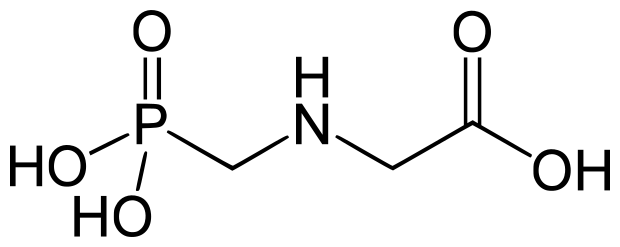
The subject of glyphosate was discussed intensively in the former working group public relations of the SEC. The discussions resulted in two open letters to the European Commission and correspondence with the Federal Railway Authority.
The starting point for the discussion was the IARC classification: “Glyphosate is probably carcinogenic” (2015). In a first open letter to the European Commission dated 16 June 2020, we expressed doubts about this statement. The Commission responded positively on 14 June 2026. This encouraged us to support the further activities of various expert groups in the EU.
As the EU’s Assessment Group Glyphosate has impressively confirmed, glyphosate per se does not cause a carcinogenic effect in humans. However, certain components of the herbicide formulation could substantiate the suspicion of carcinogenicity. This prompted us, in a second open letter dated 18 May 2022, to ask the Commission to support intensive research into the different formulations available on the market. We received encouraging responses from the EU and the Federal Institute for Risk Assessment (BfR). We believe that a general ban on glyphosate-containing formulations would have a significant negative impact on global food security.
Deutsche Bahn is the largest single consumer of glyphosate in the Federal Republic of Germany, because the ballast bed of the tracks must be kept free of vegetation for safety reasons. However, it has announced that it intends to replace glyphosate with pelargonic acid in future. In a letter to the Federal Railway Authority (EBA) dated 14 April 2023, we expressed doubts as to whether the planned glyphosate substitute would ensure the safety of high-speed trains. The reply and further correspondence with the EBA are summarised in an article in Nachrichten aus der Chemie.