
School and University

    Students and Apprentices

    Undergraduate and PhD Students

    Teachers

    Higher Education Statistics

    Scholarships

Career

    Career Guidance

    Job Vacancies

    Salary Information and Income Survey

    Academy

    Mentoring

Community

    Divisions

    Young Chemists’ Forum (JCF)

    Local Sections

    Regulars' Get-Togethers

    Chem_Connect

    Equal Opportunities and Diversity

    Partnerships and International Activities

    Volunteering

    Membership

Discover Chemistry

    Top Topics

    “Nachrichten aus der Chemie” – Members’ Magazine

    Scientific Journals

    Statements and Position Papers

    Press Releases

    Brochures and Academic Publications

    Books, Videos and Podcasts

    The Fascination of Chemistry

    Cartoons

    Biographies of Female Chemists

Events

    Conferences

    Academy

    Lectures

    Further Events

Awards

    Prices

    Historical Sites of Chemistry

About Us

    Board and Other Bodies

    The Office

    Statutes and Code of Conduct

    Charities

    Press and Public Relations

    Sustainability

MyGDCh

GDCh

Chemistry for a better world

© 2026 Gesellschaft Deutscher Chemiker. All rights reserved.

NewsletterDownloadsPressContactGDCh Shop
Legal NoticeData PrivacyTerms & Conditions
Homepage/Divisions/Senior Expert Chemists/Technology Tour/2013 Merck
Technology Tour

2013 Merck

2013 Merck

Forest Spiral and Light-Emitting Diode

5th SEC Technology Tour: Senior chemists from GDCh and VAA visit the Hundertwasser House and Merck in Darmstadt.

A tried-and-tested concept: joint excursions by Senior Expert Chemists (SEC) of the GDCh and retired VAA members of the Hanau-Wolfgang site group. Technology combined with art and enjoyment: the fifth SEC Technology Tour took place on 14 November 2013. The programme included the Waldspirale (the Hundertwasser House) and the company Merck in Darmstadt.

Merck

Ulrike Strobl, a fellow chemist, organised the visit to Merck to perfection. In advance, we had chosen organic light-emitting diodes (OLEDs) as the main topic. Merck is currently conducting intensive research in this field. Before that, however, the senior citizens were able to admire Merck’s plant site in Darmstadt, covering more than 1 km², from the bus. Afterwards, Dr Voges from OLED research welcomed them with a lecture on how organic light-emitting diodes work and their possible applications — naturally with the help of an OLED screen measuring several square metres. The core of an OLED is a thin layer of semiconducting organic compounds that emits light when a voltage is applied. OLED displays emit light themselves and therefore, unlike LCD screens, do not require backlighting. In addition, they can be produced on curved or even flexible materials, display rich colours and, above all, deep blacks. Thanks to the possibility of printing the display electronics onto a substrate (rather than vapour-depositing them), OLED screens could be manufactured much more cheaply in the future. The new OLED research building at Merck was inaugurated in 2010 in the presence of the Federal Chancellor. Costing EUR 50 million, it is the largest single investment in the history of Merck research. The senior citizens were able to admire the latest generation of curved and even transparent screens, including 3D displays. They were even able to take a tour of the OLED testing laboratories and admire the cleanrooms from outside. Following this, Dr. Thomas Geelhaar, spokesperson for chemical research, provided an insight into the methods Merck uses to find ideas for the future. Connecting young talent and facilitating dialogue between experienced R&D managers and top students play a major role here. But new applications are also constantly being developed for the now mature LCD technology — Merck has a global market share of more than 60% in this sector. For Merck, this means close cooperation on site with key customers in Korea, China and Japan. After an overview of the company’s history and the Merck family, the senior citizens were able to reflect on their many impressions over coffee and cake.

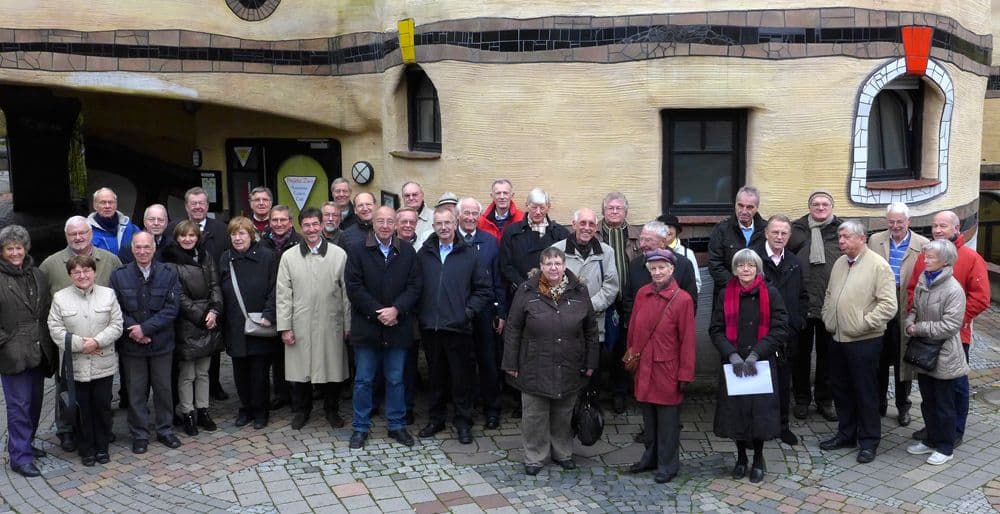
Waldsprirale

The Waldspirale is a late work by the Austrian artist Friedensreich Hundertwasser. He died in 2000, shortly before the building was completed. The large building, with 102 flats, a café and a restaurant, winds around an inner courtyard in a large spiral. Together with the architect Springmann, Hundertwasser consistently implemented his concept. For the artist, the spiral is a symbol of communication and closeness; two highly visible golden onion domes crown the building, an allusion to Hundertwasser’s Jewish heritage and a symbol of wealth. Above all, he avoids every straight line! In the “Mould Manifesto”, he wrote in 1958: “Today we live in a chaos of straight lines...” and later: “The straight line is godless.” Every window in the building is unique. Nature has been carefully incorporated in the form of trees and a stream, while the roof surfaces of the spiral ramp are consistently covered with woodland.

Technology Tours

SEC technology tours are currently organised by Wolfgang Gerhartz, Tel. 06251-938558. Suggestions for the organisation of future excursions are welcome.