
2007 Sanofi-Aventis
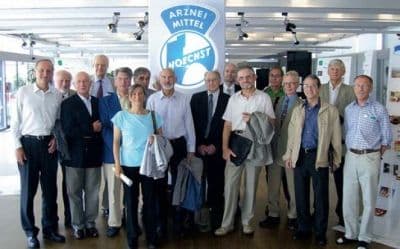
After six months of planning, the time had finally come on 23 May 2007: the first Technology Tour organised by the Senior Expert Chemists took place at the Höchst Industrial Park in Frankfurt. Sanofi-Aventis, one of the leading pharmaceutical companies, had extended the invitation. The tour began at the historical exhibition at the East Gate, looking back at the roots of the former Hoechst and, above all, at the progress made at the Höchst site in recent years.
Today, more than 22,000 people work there, meaning that considerably more people are employed on the industrial site than in the mid-1990s. The detour to the listed Peter Behrens Building, once the basis for Hoechst’s emblem of bridge and tower, served solely to admire the architectural secrets of this remarkable industrial building in the Bauhaus style.
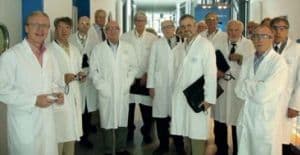
The tour then continued to the heart of Sanofi-Aventis: a research building in the south of the industrial park protected by the highest security standards. Here, laboratory and group leaders explained the latest research trends, as well as the daily routine. Today, for example, it is standard practice for chemists to characterise new substances fully automatically within a few hours, using both an NMR spectrum and a mass spectrum. Faced with such modern high technology, more than one participant was tempted to draw a historical comparison with their own work in the laboratory.
The presentations on protein crystallisation were equally fascinating. Biologists and chemists are now able to screen substantially more samples and initiate more structure elucidation projects per year than they could just a few years ago. It came as a surprise to everyone present that outsourcing is now used here too: microscope images of the crystallisation process are sent by data transfer to China for evaluation.
After the lunch break in the casino, where the researchers from Sanofi-Aventis were available for discussions, the day concluded with a bus tour of the industrial park. At 4.6 square kilometres, with 72 km of roads, 57 km of railway tracks and now around 90 companies based there, the park is likely to be one of Europe’s most important chemical and pharmaceutical locations.
On behalf of all participants, our thanks go to Dr. Uwe Gerlach, Dr. Ulrich Wendt, Dr. Martin Will, Dr. Kai Bruns, graduate engineer Maik Fredersdorf and graduate engineer Mathias Schaffrath, and above all to our full-day guide, Dr. Cäcilia Glück-Machholdt, who made this informative and entertaining day possible.
The series of excursions in the Technology Tours format for Senior Expert Chemists is to continue, including beyond the Rhine-Main region. Many thanks in advance for suggestions and organisational assistance from the ranks of the Senior Expert Chemists.
Contact: Dr. Holger Bengs, GDCh, Tel. 069 7917 356
(From Nachr. Chem. 2007, 55, 920.)