
2013 Merck
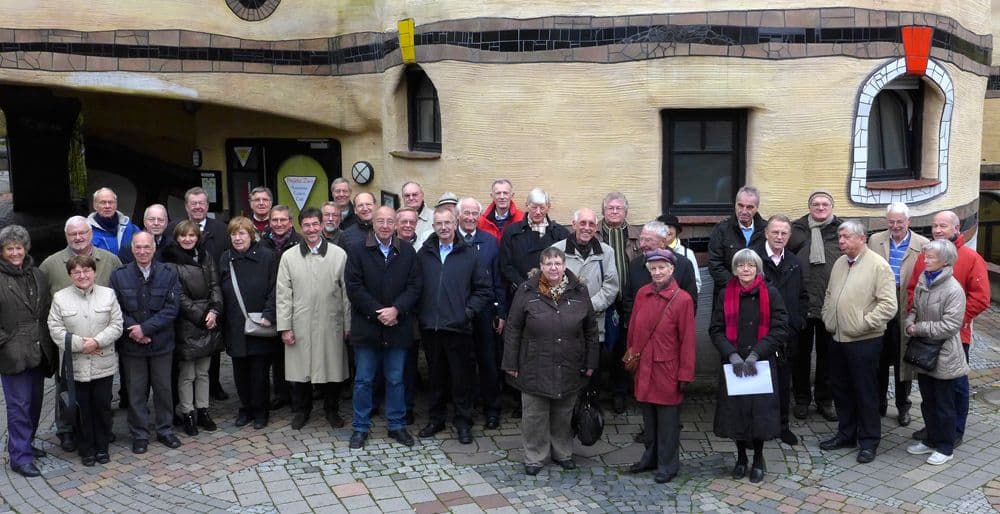
5th SEC Technology Tour: Senior chemists from GDCh and VAA visit the Hundertwasser House and Merck in Darmstadt.
A tried-and-tested concept: joint excursions by Senior Expert Chemists (SEC) of the GDCh and retired VAA members of the Hanau-Wolfgang site group. Technology combined with art and enjoyment: the fifth SEC Technology Tour took place on 14 November 2013. The programme included the Waldspirale (the Hundertwasser House) and the company Merck in Darmstadt.
Ulrike Strobl, a fellow chemist, organised the visit to Merck to perfection. In advance, we had chosen organic light-emitting diodes (OLEDs) as the main focus. Merck is currently conducting intensive research in this field. Before that, however, the seniors were able to admire Merck’s factory premises in Darmstadt, covering more than 1 km2, from the bus. Dr Voges from OLED research then welcomed them with a lecture on the operating principles and possible applications of organic light-emitting diodes — naturally with the help of an OLED screen several square metres in size. The core component of an OLED is a thin layer of semiconducting organic compounds that emits light when a voltage is applied. OLED displays emit light themselves and therefore, unlike LCD screens, require no backlighting. They can also be produced on curved or even flexible materials, display rich colours and, above all, deep blacks. Thanks to the possibility of printing the display electronics onto a substrate (rather than vapour-depositing them), OLED screens can be manufactured much more cheaply in the future. Merck’s new OLED research building was opened in 2010 in the presence of the Federal Chancellor. At EUR 50 million, it is the largest single investment in the history of Merck research. The seniors were able to admire the latest generation of curved and even transparent screens, including 3D displays. They were even able to take a tour of the OLED testing laboratories and view the clean rooms from outside. Afterwards, Dr Thomas Geelhaar, spokesperson for chemical research, gave an insight into the methods used at Merck to find ideas for the future. Connecting young talent and fostering dialogue between experienced R&D managers and top students play a major role here. But new applications are also constantly being developed for LCD technology, which is now mature — Merck has a worldwide market share of more than 60% in this sector. For Merck, this means close cooperation with major customers on site in Korea, China and Japan. After an overview of the company’s history and the Merck family, the seniors were able to reflect on their many impressions over coffee and cake.