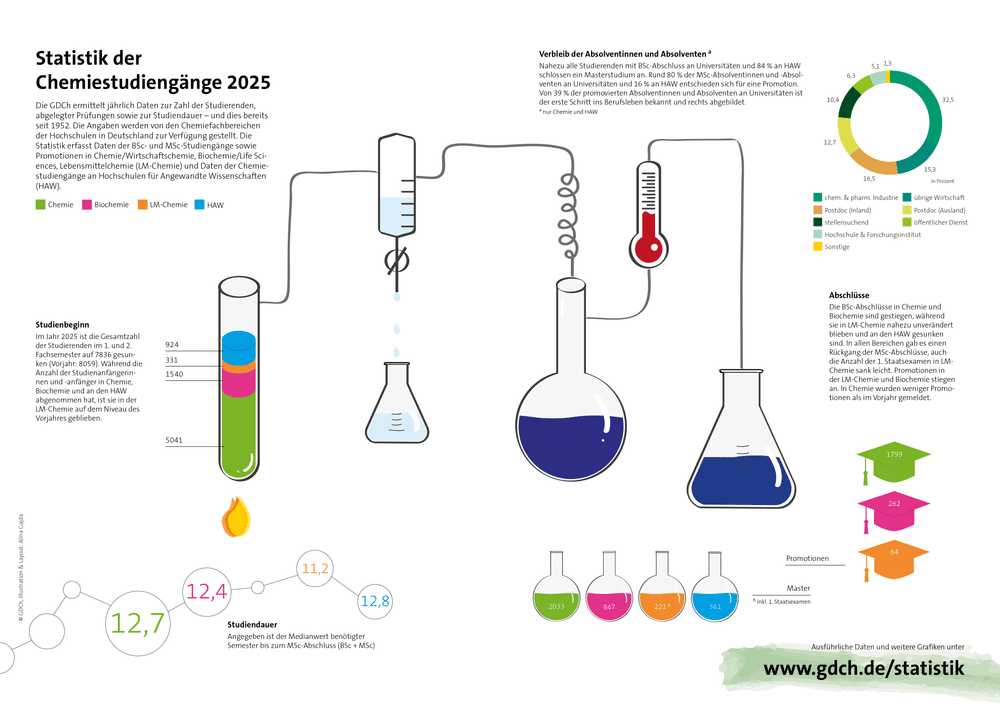
Statistics on chemistry degree programmes
... is not just any publication of ours, but the GDCh’s most important annual publication. How many first-year students are there, and where? How many students have completed their Master’s degree, how long do people actually study, and where do they all end up? With 60 pages, 20 graphics and 38 tables, hardly any question remains unanswered.
Our statistics record data on Bachelor’s and Master’s degree programmes and doctoral studies in chemistry/business chemistry, biochemistry/life sciences, food chemistry (food chemistry) and data on chemistry degree programmes at universities of applied sciences (HAW).
The brochure "Statistics on Chemistry Degree Programmes – A GDCh survey of chemistry degree programmes at universities and universities of applied sciences in Germany" is published annually in July. You can view and download the brochure containing all the data, tables and graphics free of charge as a PDF brochure .
In addition, a graphical presentation of the most important data is published in Nachrichten aus der Chemie, issue 7/8 (2026).
You will also find the most important graphics from the statistics on these pages as PDFs for download.
In scientific subjects, the dissertation in the form of a monograph has now been supplemented by the alternative of the cumulative format. Cumulative dissertations are publication-based; i.e. doctoral candidates can write their dissertation through publications that have been published in peer-reviewed recognised journals and belong to a thematically coherent subject area. The conditions can be found in the examination regulations of the respective higher education institution. Differences exist, for example, in the number of publications required and the relevance of authorship/first authorship.
According to the GDCh survey of German higher education institutions, a cumulative doctorate in chemistry is therefore possible at 47 of 55 higher education institutions, and in biochemistry at 22 of 35 higher education institutions.
Universities fight as committedly over hardly any figure as they do over the length of study. After all, short study periods are an important advantage in the competition for students. To ensure that individual students who, because of illness, part-time jobs or other reasons, take substantially longer than average to reach their examinations do not “spoil” their university’s figure, the median values, also known as 50% values, are calculated from the data provided by the universities. They ensure that particularly slow students, as well as the “high-flyers” with extremely short study periods, are disregarded, and allow study durations to be compared more effectively than with the arithmetic mean. You can read here exactly what the median value is and how it is calculated.