
Teaching materials
High-quality, free teaching materials are available for you to download. The interactive slide sets comply with curricula and can be used paperlessly in lessons straight away.
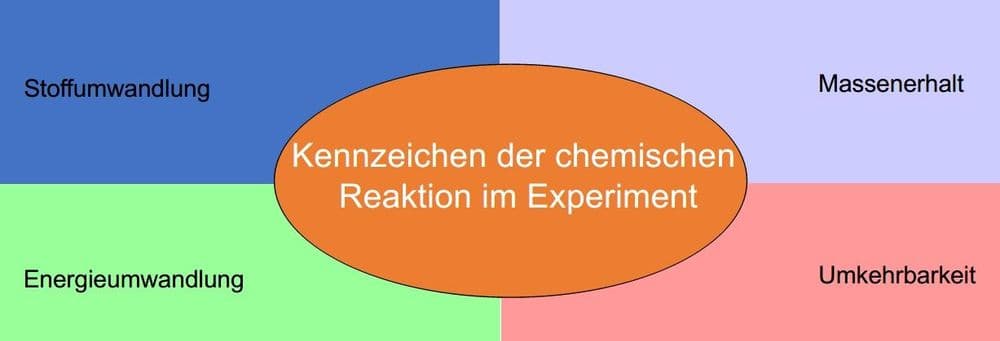
To allow pupils to carry out experiments, the teacher must ensure the following requirements:
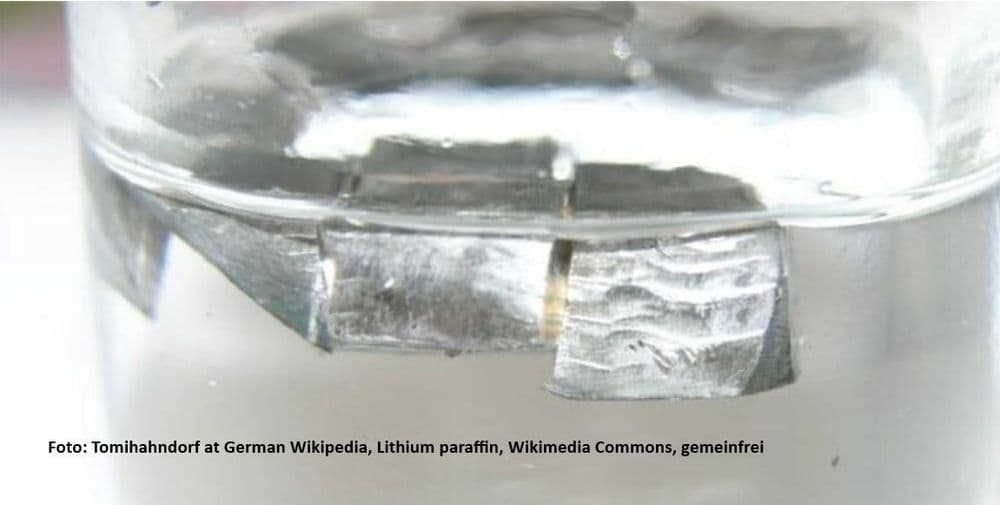
The first part of the teaching materials is suitable for lower secondary level (SEK I) from the 2nd year of learning onwards, as well as for upper secondary level (OS), while the second part is suitable only for upper secondary level.
1. Element lithium – properties with links to YOUTUBE experiments
2. Slides on the most important applications of the lithium-ion battery,
the world's largest deposits and the extraction of lithium
3. Diagram of a fused-salt electrolysis process for the synthesis of lithium
4. Diagram illustrating how a lithium-ion battery works
5. Recycling lithium batteries
6. toxicology of lithium and its compounds
Slides for download – teaching materials
Notes pages for download – teacher's guide
The use of fossil energy and the resulting increase in greenhouse gas emissions are having an ever greater impact on our climate and threatening life on our planet. Moving away from fossil fuels towards renewable energy is therefore an essential prerequisite for safeguarding our ecological and economic future.
The material provided below is suitable for internal STEM training sessions. The slides and notes pages provide clear, comprehensive and objective information about the technological foundations and their significance for sustainable living on our planet.
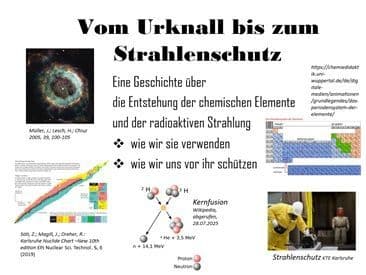
The slides illustrate the whole of nuclear chemistry. They take you through space and back to Earth, and show you how the Big Bang and the time afterwards brought matter into our universe. You will learn how fusion, transmutation and nuclear fission produced chemical elements, solar systems—i.e. stars (suns) and planets—as well as energy from elementary particles. Natural radioactive isotopes have existed ever since the existence of elements. In addition, humans produce further radioactive isotopes artificially. Radioactive radiation must be measured and monitored so that it can be used sensibly in medicine and technology without causing harm.
The teaching material is suitable for supplementing and deepening lessons when introducing the chemical elements in the periodic table and/or differentiated atomic models.
The teaching material is suitable for supplementing and deepening lessons on radiation and isotopes