
Nursery school
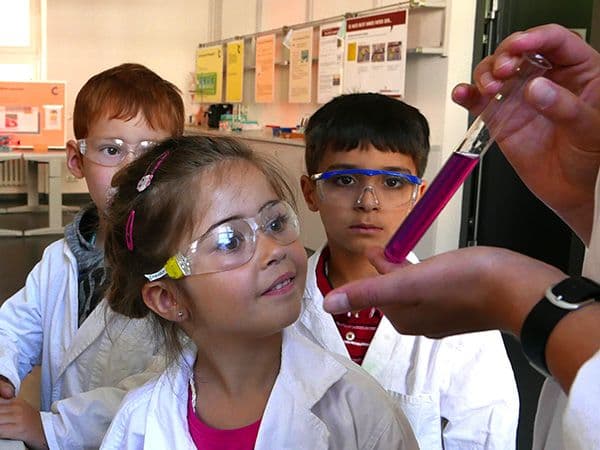
The future of technology-oriented societies depends to a considerable extent on their capabilities in the STEM subjects (STEM = science, technology, engineering and mathematics). For many initiatives, this is the reason for becoming involved in early education. In nurseries and primary schools, children’s interest in science, technology and mathematics is awakened and encouraged.
Children are naturally curious, inquisitive – Why? – researchers. However, success in nurseries and primary schools can only be achieved if nursery and primary school staff are able to transfer their personal enthusiasm for scientific questions to the children.
Many members of staff in nurseries and primary schools do not feel confident enough to become actively involved in early education because their knowledge is insufficient and the necessary experimental materials, and often the premises too, are not available.
In such cases, a senior citizen with professional and life experience can make a considerable contribution as a “mentor” towards closing knowledge gaps and can also provide assistance in setting up a research box or research laboratory.
Experimenting together with nursery staff, children and senior citizens is generally a success for everyone involved. The children’s interest and enthusiasm are the reward for the senior citizen and mentor for their work. There are no more grateful “colleagues”!
Everything a mentor needs to get started (documents, literature and experimental materials) is easy and inexpensive to obtain. The Kinder forschen Foundation (formerly: “Haus der kleinen Forscher”), for example, provides every conceivable form of support for getting started as a nursery mentor.
Below are some example keywords for internet research, which provide a good overview of the environment associated with early science education.
There is no one-size-fits-all recipe for starting an initiative at a nursery. The prospective mentor first chooses a nursery whose management is interested in early education and enthusiastically agrees to the proposal to introduce experimental science education at the nursery. The nursery and mentor develop a concept tailored to the nursery’s infrastructure, after which the nursery staff, children and mentor begin carrying out simple experiments. There is then nothing to prevent the collaboration from developing further, right up to certification by Haus der kleinen Forscher.
It works, and the author of this text has experienced this several times already. Having a sponsor naturally makes getting started easier. In my case, this was and remains Degussa and Evonik Industries AG.
Heinz Delle