School and University

    Students and Apprentices

    Undergraduate and PhD Students

    Teachers

    Higher Education Statistics

    Scholarships

Career

    Career Guidance

    Job Vacancies

    Salary Information and Income Survey

    Academy

    Mentoring

Community

    Divisions

    Young Chemists’ Forum (JCF)

    Local Sections

    Regulars' Get-Togethers

    Chem_Connect

    Equal Opportunities and Diversity

    Partnerships and International Activities

    Volunteering

    Membership

Discover Chemistry

    Top Topics

    “Nachrichten aus der Chemie” – Members’ Magazine

    Scientific Journals

    Statements and Position Papers

    Press Releases

    Brochures and Academic Publications

    Books, Videos and Podcasts

    The Fascination of Chemistry

    Cartoons

    Biographies of Female Chemists

Events

    Conferences

    Academy

    Lectures

    Further Events

Awards

    Prices

    Historical Sites of Chemistry

About Us

    Board and Other Bodies

    The Office

    Statutes and Code of Conduct

    Charities

    Press and Public Relations

    Sustainability

MyGDCh

GDCh

Chemistry for a better world

© 2026 Gesellschaft Deutscher Chemiker. All rights reserved.

NewsletterDownloadsPressContactGDCh Shop
Legal NoticeData PrivacyTerms & Conditions
Homepage/Divisions/Senior Expert Chemists/Online lectures/Werner Hoffmann
Online lectures

Werner Hoffmann

Werner Hoffmann

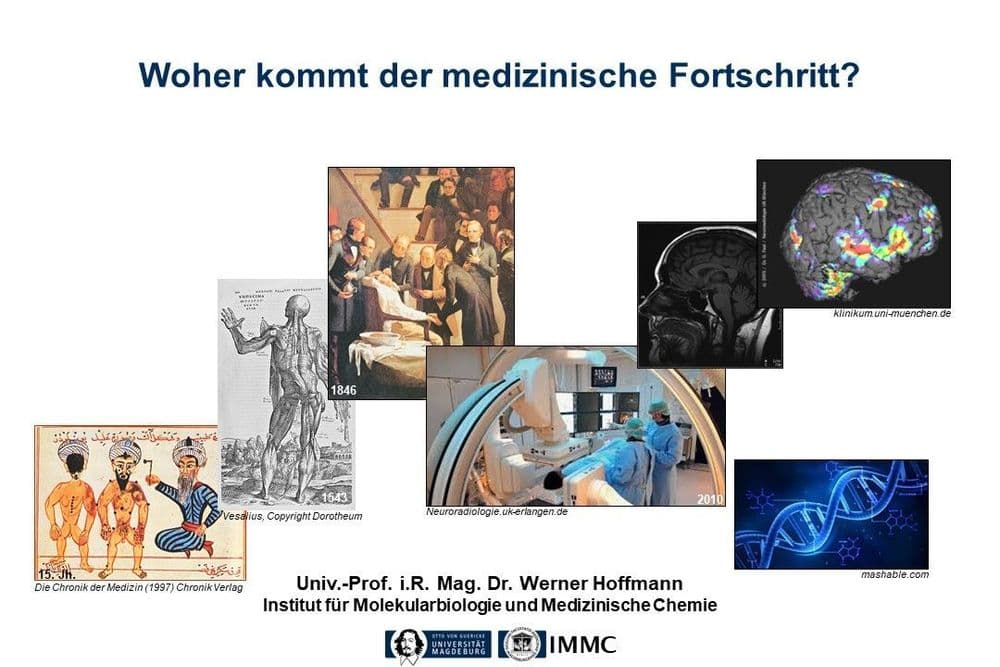
Where does medical progress come from?

Online lecture by Werner Hoffmann on 13 May 2025, 3 pm

Moderator: Petra Schultheiß-Reimann

Until the end of the Middle Ages, Hippocratic-Galenic medicine in particular, along with Arab influences, shaped medical practice in Europe for more than 1,300 years. With the beginning of the Renaissance, a rapid and diverse cultural development began in Europe. As a result, from around the middle of the 18th century onwards, a paradigm shift gradually took place in medicine in Europe. From then on, physiological processes and diseases were explained at cellular and molecular level. As a consequence of this new perspective, there were tremendous advances in medical diagnostics and therapy, particularly over the last 180 years – and this rapid development is still continuing unabated.

This raises the question of what triggered this new dynamism and what lies behind the exponential progress of medicine today. What can we expect for the future?