
School and University

    Students and Apprentices

    Undergraduate and PhD Students

    Teachers

    Higher Education Statistics

    Scholarships

Career

    Career Guidance

    Job Vacancies

    Salary Information and Income Survey

    Academy

    Mentoring

Community

    Divisions

    Young Chemists’ Forum (JCF)

    Local Sections

    Regulars' Get-Togethers

    Chem_Connect

    Equal Opportunities and Diversity

    Partnerships and International Activities

    Volunteering

    Membership

Discover Chemistry

    Top Topics

    “Nachrichten aus der Chemie” – Members’ Magazine

    Specialist Journals

    Statements and Position Papers

    Press Releases

    Brochures and Academic Publications

    Books, Videos and Podcasts

    The Fascination of Chemistry

    Cartoons

    Biographies of Female Chemists

Events

    Conferences

    Academy

    Lectures

    Further Events

Awards

    Prizes

    Historical Sites Relating to Chemistry

About Us

    Board and Other Bodies

    The Office

    Statutes and Code of Conduct

    Foundations

    Press and Public Relations

    Sustainability

MyGDCh

GDCh

Chemistry for a better world

© 2026 Gesellschaft Deutscher Chemiker. All rights reserved.

NewsletterDownloadsPressContactGDCh Shop
Legal NoticeData PrivacyTerms & ConditionsSubmit a revocation
Homepage/Divisions/Senior Expert Chemists/Online lectures/Thomas A. Vilgis
Online lectures

Thomas A. Vilgis

Thomas A. Vilgis

Christmas biscuits – indulgent materials between rubbery and glassy phases #

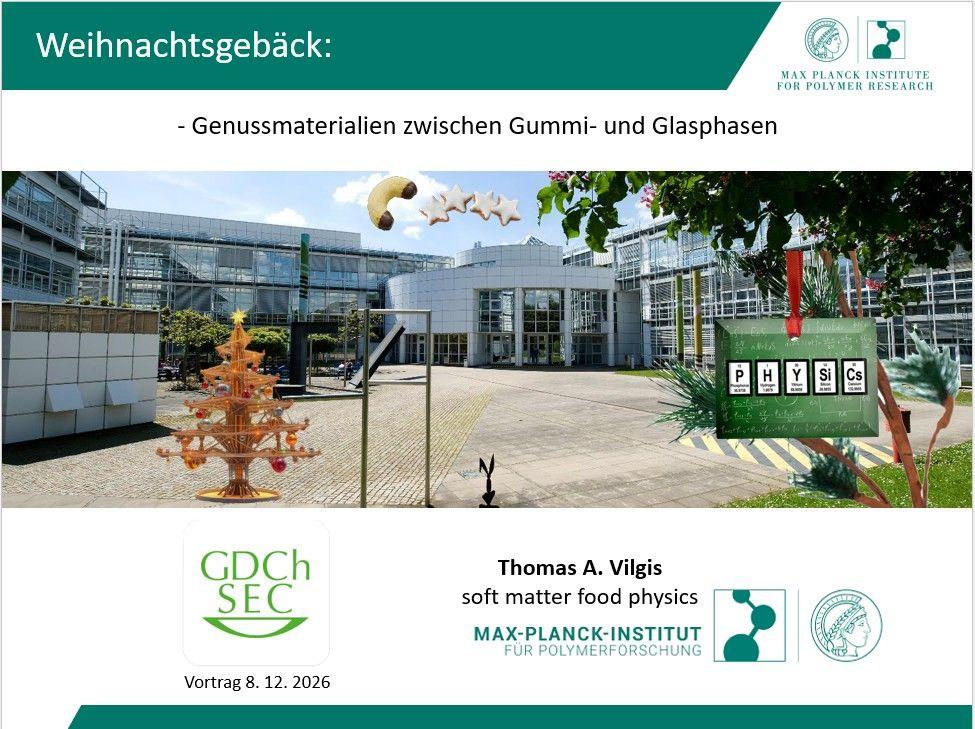
Vilgis TItelfolie

Online lecture by Thomas A. Vilgis on 8 December 2026, 15:00

Chair: Petra Schultheiß-Reimann

What at first glance looks like nothing more than the art of baking can be explained perfectly well using the concepts of soft matter physics (Soft Matter Food Physics). The lecture explores how water content, temperature and molecular structure determine the texture of traditional Christmas biscuits – from rubber-elastic polymer networks to brittle solids. Examples include entropic-elastic gluten networks and starch gelatinisation in panettone, surface-active egg-white proteins acting as a glue for granular almond systems in cinnamon stars, fat-induced weak points in low-moisture vanilla crescents, and targeted glass transitions in Springerle biscuits. This illustrates how, at the microscopic level, these structures control the way the biscuits break in the mouth and release their aromas.

ZOOM - Link: 🔗 https://us06web.zoom.us/j/84042184878?pwd=09gOdrb9YBZKhQp68ID22JVLcpVSvF.1
Meeting ID: 840 4218 4878; Passcode: 463346

Before the main lecture, there will be a five-minute start-up presentation. H/F NAME will present the company (WEB) and give a lecture on the topic TITLE.

MINI ABSTRACT (2 sentences)

Thomas Vilgis2