School and University

    Students and Apprentices

    Undergraduate and PhD Students

    Teachers

    Higher Education Statistics

    Scholarships

Career

    Career Guidance

    Job Vacancies

    Salary Information and Income Survey

    Academy

    Mentoring

Community

    Divisions

    Young Chemists’ Forum (JCF)

    Local Sections

    Regulars' Get-Togethers

    Chem_Connect

    Equal Opportunities and Diversity

    Partnerships and International Activities

    Volunteering

    Membership

Discover Chemistry

    Top Topics

    “Nachrichten aus der Chemie” – Members’ Magazine

    Scientific Journals

    Statements and Position Papers

    Press Releases

    Brochures and Academic Publications

    Books, Videos and Podcasts

    The Fascination of Chemistry

    Cartoons

    Biographies of Female Chemists

Events

    Conferences

    Academy

    Lectures

    Further Events

Awards

    Prices

    Historical Sites of Chemistry

About Us

    Board and Other Bodies

    The Office

    Statutes and Code of Conduct

    Charities

    Press and Public Relations

    Sustainability

MyGDCh

GDCh

Chemistry for a better world

© 2026 Gesellschaft Deutscher Chemiker. All rights reserved.

NewsletterDownloadsPressContactGDCh Shop
Legal NoticeData PrivacyTerms & Conditions
Homepage/Divisions/Senior Expert Chemists/Online lectures/Thomas Müller-Kirschbaum
Online lectures

Thomas Müller-Kirschbaum
Thomas Müller-Kirschbaum

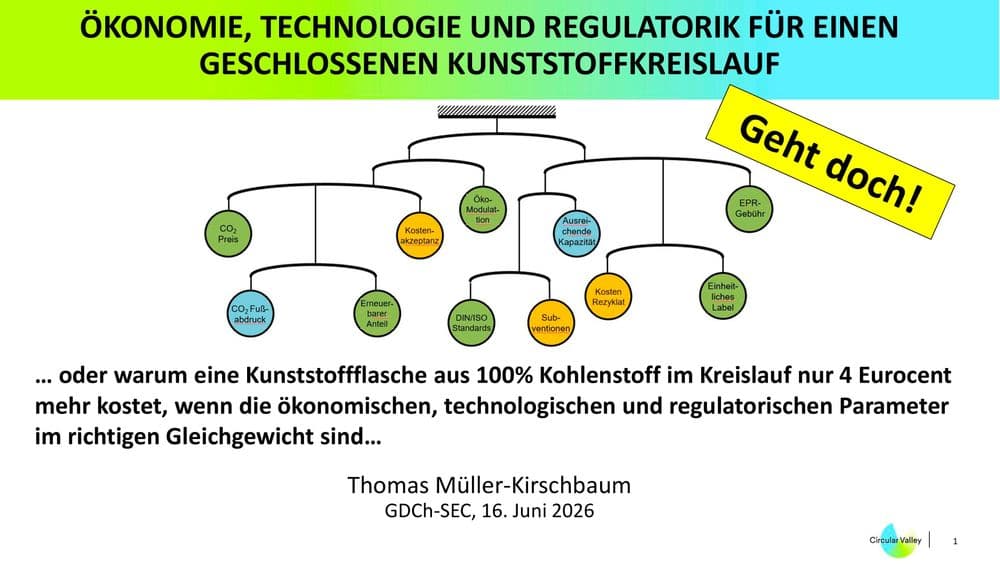
Economics, Technology and Regulation for a Closed-Loop Plastics Cycle

Online lecture by Thomas Müller-Kirschbaum on 16 June 2026, 3 pm

Moderation: Petra Schultheiß-Reimann

Plastics – particularly in the packaging sector – are condemned by some as harmful to the environment, while others praise them as sustainable product protection. The right approach is crucial. The question repeatedly arises as to whether a completely closed loop would be possible not only technologically, but also economically. A climate-neutral circular economy must manage without additional fossil carbon inputs. Based on an acatech study for the BMBF, in which the author was involved, a scenario for a completely closed plastics loop in the packaging sector by 2035 is presented using the commodity plastics polyethylene, polypropylene and PET. The model shows that just 4 euro cents in additional costs for a product in a plastic bottle with a net weight of 100 g are sufficient, provided that the technological, economic and regulatory parameters are in the right balance.

Zoom link to the lecture: https://us06web.zoom.us/j/89080704305?pwd=4MI6xgap1SZ3vesEm5LUlOf8rAaPaD.1

There will be a five-minute start-up presentation before the lecture. Jerome Geils-Lindemann from AMSIS GmbH will present: Next-level metal 3D printing: cost-effective and support-free through fast simulation.