Roland Bitsch

Moderation: Eberhard Ehlers
The focus of the topic is the importance of the human water balance. The physiological function of water, its distribution among the tissues, recommended intake levels for water and fluids, and the water balance are explained. The consequences of water loss and dehydration are also discussed. Recommendations for drinking during increased physical exertion are discussed in greater detail.
Did you enjoy the lecture? Or will you be unable to attend the lecture? Then contact Prof Bitsch ; he will be happy to provide you with the slides from his lecture.
Moderation: Klaus-Dieter Jany
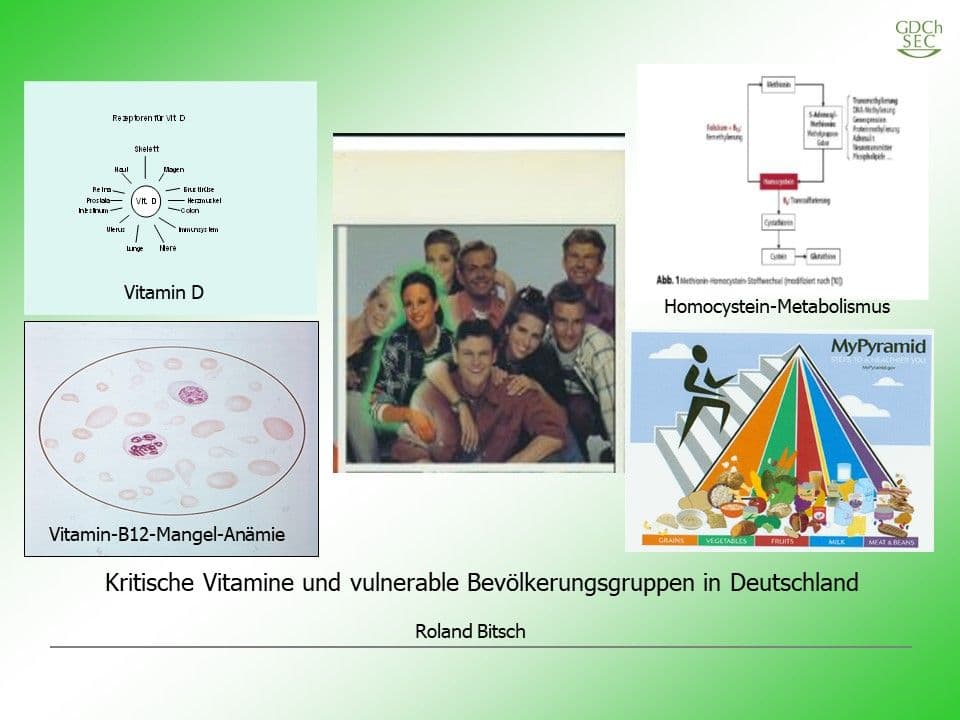
A total of 13 different vitamins are known: 4 fat-soluble and 9 water-soluble vitamins, each with specific target functions in metabolism. Uniform biosynthetic pathways exist only for fat-soluble vitamins, with acetyl coenzyme A as the starting point. The organism’s varying storage capacity is significant for the level of nutritional adequacy or the detection of vitamin deficiency stages. Limited stability in the face of external influences can sometimes lead to considerable losses during food preparation.
Recommendations regarding the intake required to meet nutritional needs, based on consumption studies, can be validated using biochemical functional parameters. In contrast to water-soluble vitamins, very high supplementation, particularly with fat-soluble vitamins A and D, can lead to intoxication, although this does not occur as part of a normal diet.
Preventive aspects in diseases are related to the physiological function of this group of nutrients, such as the prevention of osteoporosis through vitamins D and K and the prevention of neural tube defects through folic acid.
Critical vitamins with inadequate dietary intake in local population groups are vitamins D, folic acid and B12. The issue of inadequate intake of individual vitamins is discussed using risk groups such as pregnant and breastfeeding women, people with extreme or unbalanced dietary habits, gastrointestinal absorption disorders and older people.
Did you enjoy the lecture? Or will you be unable to attend the lecture? Then contact Prof Bitsch ; he will be happy to provide you with the slides from his lecture.