Kurt Wagemann
Moderation: Franz Schütz
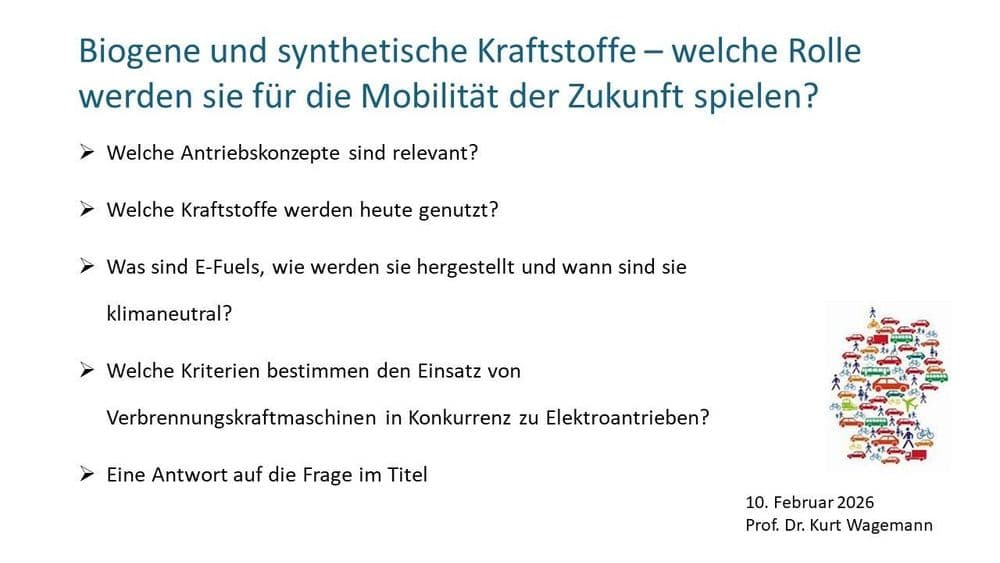
Battery-electric vehicles are the future – this statement is just as correct as it is only a partial description of future mobility.
Battery technology has advanced enormously in the recent past, and many commonly used counterarguments are no longer valid or will no longer be valid in a few years: the vehicles’ limited range, the batteries’ limited lifespan and thermal runaway, inadequate charging infrastructure, …
Despite the advantages of battery-electric mobility due to the high efficiency of using electricity, hydrogen and liquid fuels produced from it will also play an important role in a climate-neutral future. The clearest examples are long-distance air and maritime transport; however, construction machinery and military vehicles should not be forgotten.
The lecture will present the various fuels and their climate-neutral production. Finally, an attempt will be made to provide a reasonably neutral answer to the question in the title for the various forms of mobility.
Zoom link to the meeting:
https://us06web.zoom.us/j/89661258932?pwd=YPrXaepIFqtx35TdtcwaJOaDbfWUI2.1
Before the lecture, Maike Lambarth, CEO of the start-up company Cyclyze, will spend 5 minutes presenting a new process that uses plasma to produce syngas from various waste streams and CO2 (recycling).
Moderator: Eva E. Wille
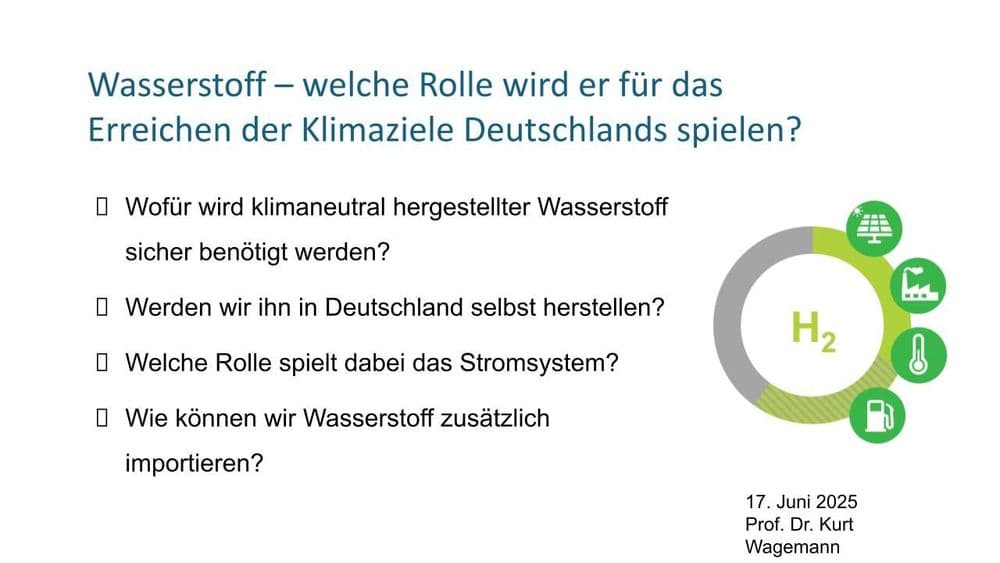
In the media, in politics, but also in academia, there are two schools of thought:
The reality of 2045 will, in all likelihood, be described by neither of these two visions of the future.
The lecture attempts to provide a neutral account: First, various methods of producing climate-neutral hydrogen will be presented. Then its use in the transport, space heating, steel and chemical sectors will be discussed. Finally, various aspects of the development of a hydrogen economy will be presented. These include, among other things, questions of location, the role of the electricity system, and the transport and distribution of hydrogen.