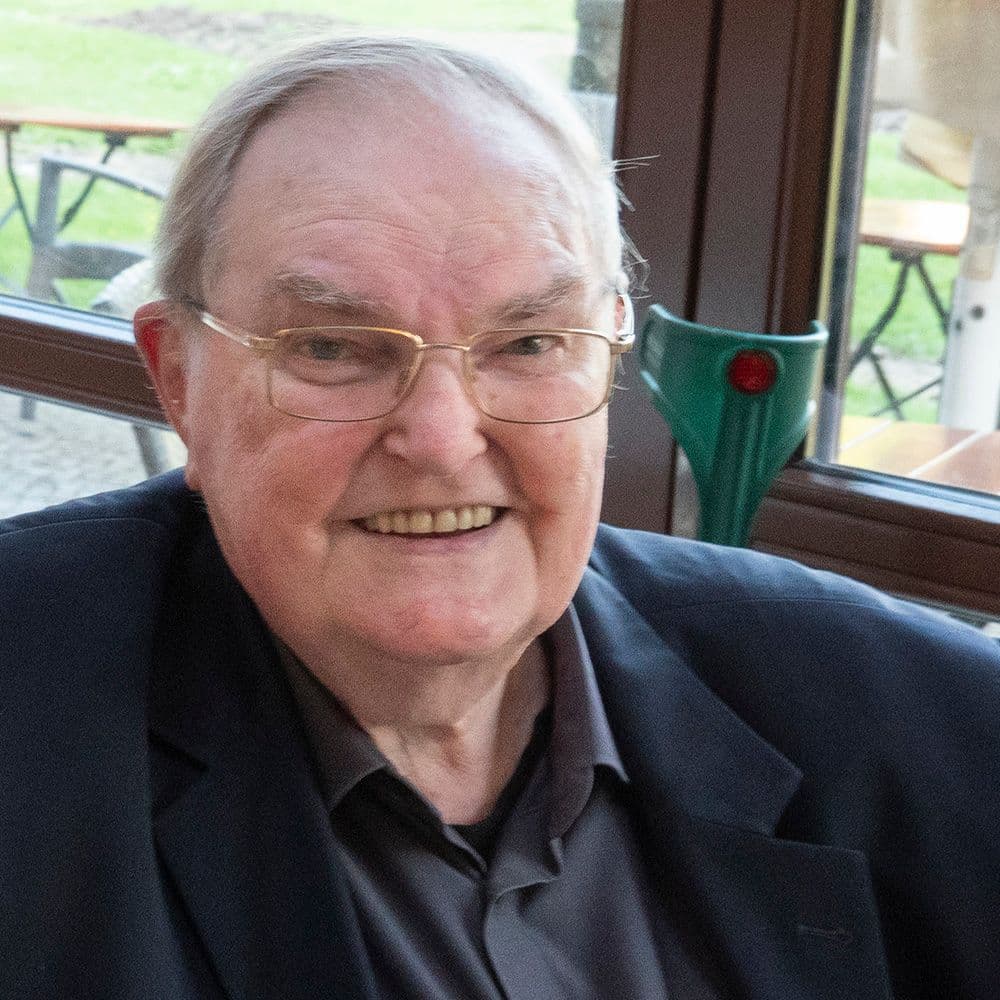
Eberhard Ehlers
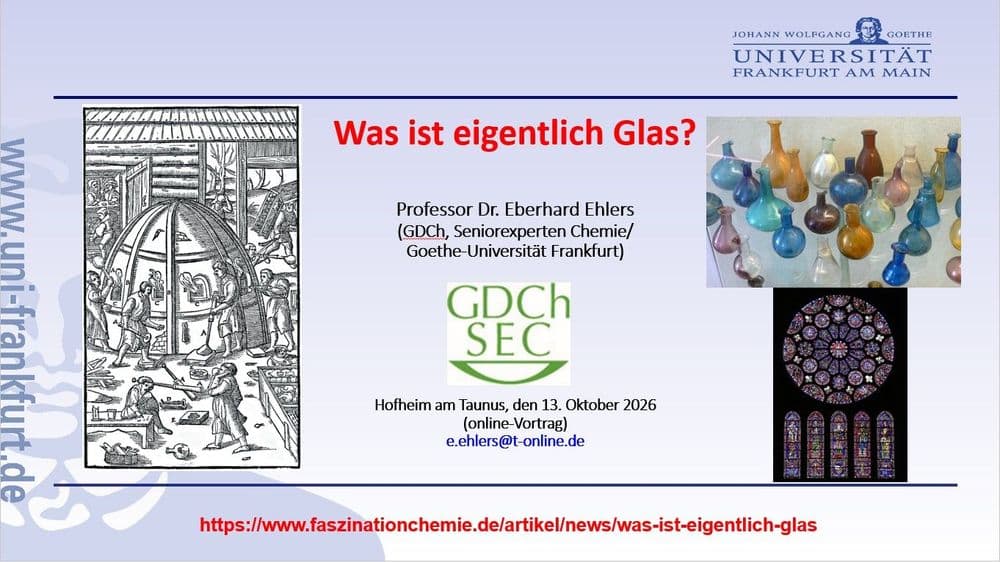
Online lecture by Eberhard Ehlers on 13 October 2026 at 3 p.m.
Chair: Wolfgang Gerhartz
Examples will be used to show why glass is such a fascinating material in research, industry, construction and private households. Starting with natural glasses (tektites, obsidians), various types of glass will be discussed – with a focus on oxide glasses – and the history of glassmaking will be outlined from antiquity to the modern era. Considerable attention will be devoted to the chemical composition of oxide glasses and to explaining typical characteristics of amorphous solids. Various types of glass (Venetian glass, Bohemian crystal glass, Thuringian Forest glass, safety glass, “fire-resistant glass”, glass-ceramics and rare-earth glasses) will be addressed. The recycling of waste glass will also be covered. The work of Carl Zeiss, Ernst Abbé and Otto Schott, as well as Marga Faulstich, at the Jena site will be discussed.
Before the lecture, there will be a five-minute start-up presentation. Dr.-Ing. Martin Groß will introduce ReViSalt GmbH and give a presentation on the topic: "New technologies for the rapid strengthening of glass". In this way, glass can become thinner, lighter, more shatter-resistant and more scratch-resistant, while using less material.
Zoom:
https://us06web.zoom.us/j/81308850232?pwd=QDDDl3JgKsTyOiUfJMBEZKjalaI7Mj.1
Chair: Wolfgang Gerhartz
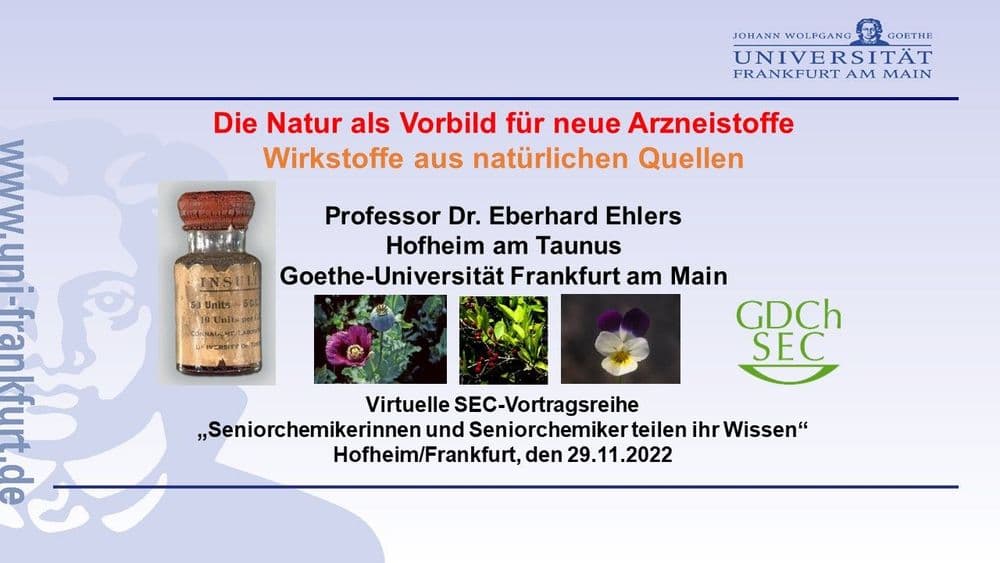
With their synthesis machinery, cells are important tools for the industrial production of new substances, particularly biopharmaceuticals. Through the production of primary and secondary metabolites, a cell’s metabolism is an important source of pharmaceutical active ingredients or lead compounds whose semi-synthetic modification yields new, therapeutically valuable medicinal substances.
An important aspect of using “cells as chemical factories” is the production of even structurally complex molecules in enantiomerically pure form under mild conditions, as demonstrated by the large-scale production of vitamin B12. Both prokaryotic [bacterial cells] and eukaryotic cells [cells from animals, plants and fungi (yeasts)] are used to obtain pharmaceutical active ingredients.
The importance of plant constituents such as morphine, cocaine and quinine for the development of highly effective analgesics, local anaesthetics and antimalarial medicines is presented. The development of the taxanes and the discovery of the antimalarial drug artemisinin are outlined as recent examples of therapeutically important natural products.
The metabolic products of numerous bacteria and fungi are now used therapeutically as antibiotics and are an indispensable tool of modern medicine for treating the most severe infections. Insulin may be cited as an example of obtaining medicinal substances from animal cells.
Biotechnological processes, and thus the use of cells as producers of active ingredients, now make a significant contribution to the production of effective medicinal substances, an important tool of modern medicine for treating life-threatening diseases.
Chair: still to be confirmed
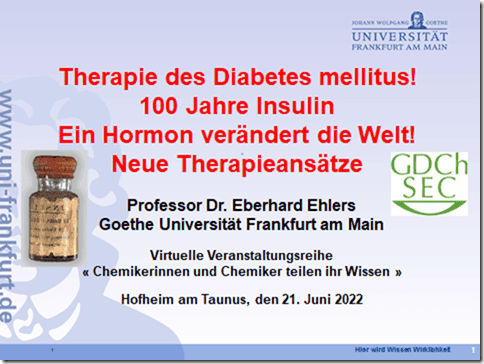
Diabetes is a widespread disease. Around 10% of German citizens and approximately 6% of the world's population suffer from it. The fundamentals of the disease, the consequential damage, as well as treatment options and therapeutic goals will be discussed.
The peptide hormone insulin plays the central role in this disease. The discovery of the hormone, the elucidation of its structure and further milestones in 100 years of insulin research will be presented. Based on an estimate of insulin requirements, various options for its industrial production will be addressed, particularly biotechnology. The terms 'genetic engineering' and 'biotechnology' will be defined.
The genetic engineering production of human insulin is a success story. Large-scale production will be explained using the production of human insulin in E. coli strains as an example; the basic principles of biotechnological processes and protein biosynthesis will be explained.
The genetic engineering production of insulin analogues led to new active-substance molecules with an improved efficacy profile being made available to people with diabetes. In addition, newer therapeutic approaches to diabetes treatment will be presented. Some aspects of the topic “How does pharmaceutical research work?” will be addressed.
Moderation: Klaus-Peter Jäckel
At the turn of the century, it was scarcely possible for women to enter the domains of men. The Abitur and university study were largely male privileges. Through acquired knowledge, great persistence, a high degree of civic courage and immense diligence, some women nevertheless attained the highest educational qualifications. They often came from wealthy families and frequently had male colleagues as mentors. Some women worked as teachers, but only a few found their way into the natural sciences. Today’s lecture will focus on such strong women who left their mark on the natural sciences—but also on women who failed and whose life’s work was neither recognised nor acknowledged.
Did you enjoy the lecture? Or will you be unable to attend the lecture? Then write to Prof. Ehlers by email; he will be happy to provide you with the slides from his lecture.