
DAAS Award
In odd-numbered years, the German Working Group for Analytical Spectroscopy (DAAS) of the GDCh Division of Analytical Chemistry presents the DAAS Award on the occasion of the ANAKON Conference in recognition of outstanding scientific work – generally doctoral theses – in the field of analytical spectroscopy, and in particular the microanalysis and trace analysis of the elements and element species. The award is intended to recognise and support outstanding young scientists at the end of, or shortly after, their doctorate degree. The award comprises a certificate and prize money of 1,500 euros donated by Merck. Nominations may be submitted exclusively by DAAS members. The award is decided by a prize committee appointed by the DAAS Board.
Following the merger of the Working Group for Microanalysis and Trace Analysis of the Elements and Element Species (A.M.S.El.) and the German Working Group for Applied Spectroscopy (DASp), the name of the award was changed from A.M.S.El. Award to DAAS Award. The prize money provided by Merck KGaA and the guidelines for awarding the prize remained unchanged.
Submission deadline: 31 October 2026
Objective
The German Working Group for Analytical Spectroscopy (DAAS) of the GDCh Division of Analytical Chemistry awards the DAAS Award every two years in recognition of outstanding scientific work in the field of analytical spectroscopy and, in particular, the microanalysis and trace analysis of the elements and element species. It is awarded in recognition and support of outstanding young scientists at the end of, or shortly after, their doctoral research.
The award
The award comprises a certificate and prize money of 1,500 euros donated by Merck. The ceremonial presentation will take place as part of ANAKON 2027, which will be held in Mainz from 5 to 8 April 2027. Following the presentation, the awardee will have the opportunity to present their research in a half-hour lecture. The DAAS will cover the costs of attending the conference. The decision on the award will be made by an independent jury comprising members of the DAAS Executive Board, external advisers and a representative of Merck KGaA.
Nomination
Members of the DAAS are entitled to submit nominations. Self-nominations are excluded. All nominations in German or English must include the following documents:
Submission
Please send your nomination by email and consolidated into a single PDF file to Dr. Ann-Christin Niehoff.
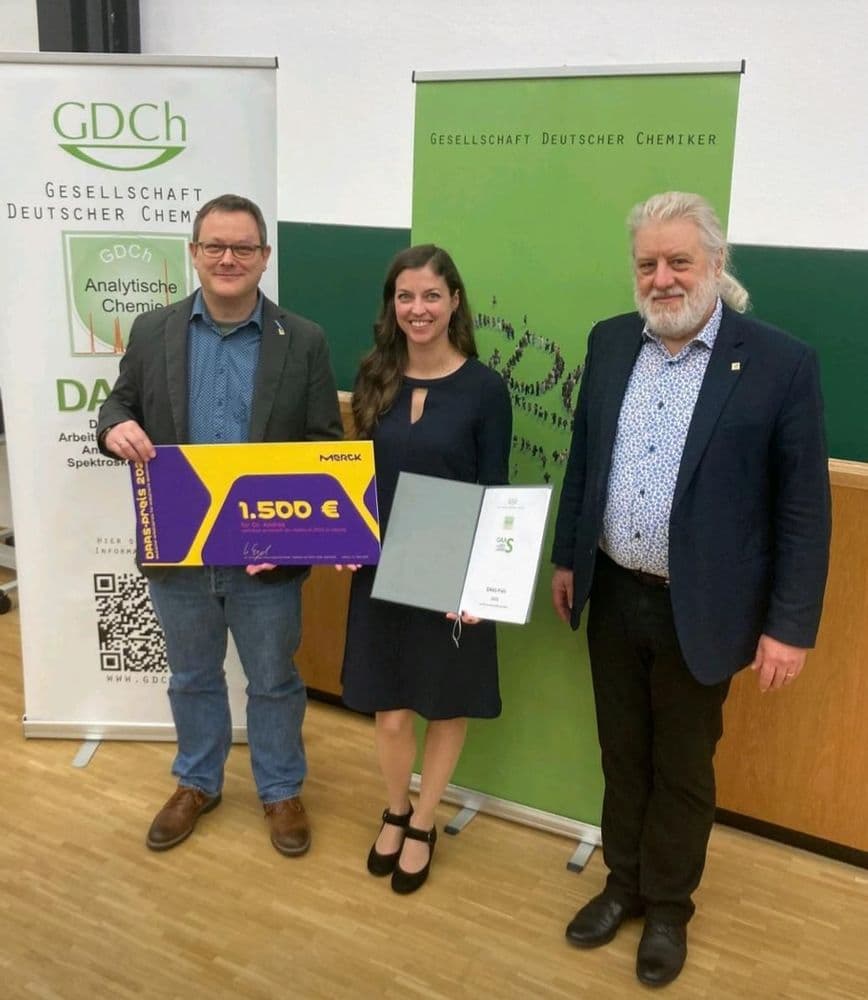
The award donated by Merck KGaA, Darmstadt, was presented to Dr. Andrea Teuber at ANAKON 2025 in Leipzig – in recognition of her dissertation, completed under the supervision of Prof. Dr. Boris Mizaikoff at Ulm University, entitled "Advanced Quantum Cascade Laser Infrared Attenuated Total Reflection Spectroscopy":
"Andrea Teuber was the first to use thin-film waveguide sensors under extreme conditions, for example for biofilm analyses, and she played a major role in advancing vibrational spectroscopy. This includes further developing ATR technology, further miniaturisation, improving robustness and thus expanding the fields of application of vibrational spectroscopy. Ms Teuber's achievements are best characterised by seven publications as first author in renowned journals and several conference contributions on quantum cascade lasers, as well as sensor development in the mid-infrared range with various state-of-the-art applications."
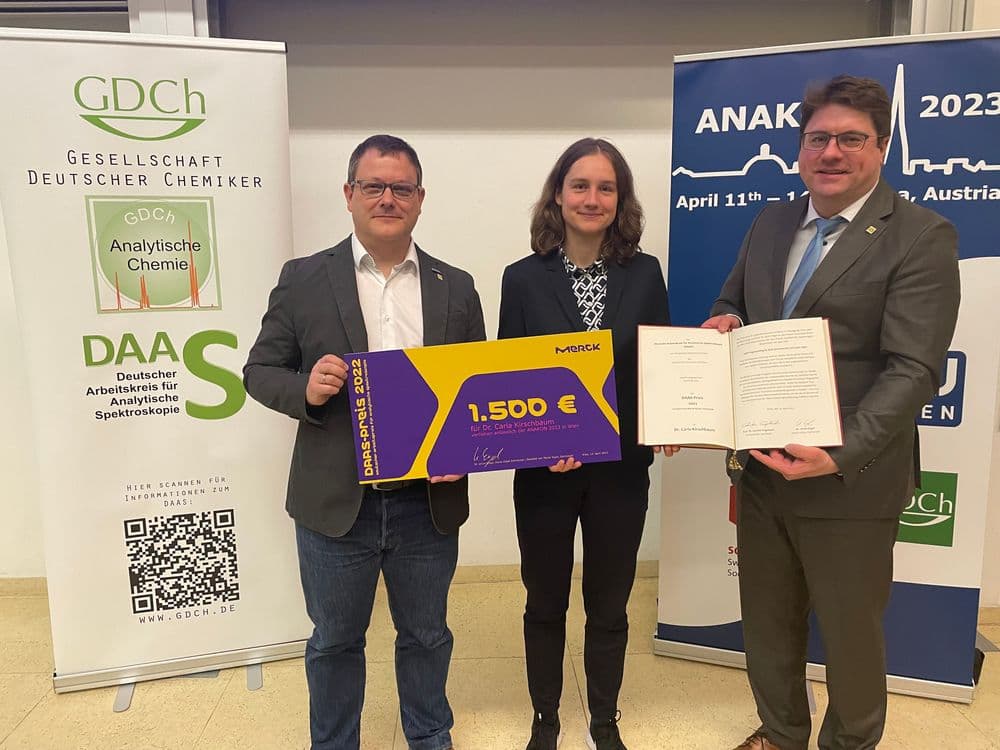
The award was presented to Dr. Carla Kirschbaum at ANAKON 2023 in Vienna, in recognition of her dissertation entitled "Lipid Fingerprinting by Mass Spectrometry and Laser Light", completed under the supervision of Prof. Dr. Kevin Pagel at Freie Universität Berlin and the Fritz Haber Institute of the Max Planck Society:
"The significance of Ms Kirschbaum's work is best illustrated by six awards and fifteen publications on the subject of analytical spectroscopy of lipids, some of which appeared in the most prestigious journals. She was the first to use cryogenic infrared action spectroscopy to study complex biomolecules. In particular, she was able to distinguish between isomers of glycolipids, sphingolipids and fatty acids using fingerprints in the infrared spectrum. Ms Kirschbaum's work is also impressive in that she has engaged with a wide range of analytical spectrometric techniques – such as tandem mass spectrometry, with which she was able to elucidate the mechanism of glycerolipid fragmentation in an impressive manner."
The prize was awarded to Dr Gerrit Renner during the virtual DAAS doctoral seminar for his dissertation completed at the University of Duisburg-Essen.
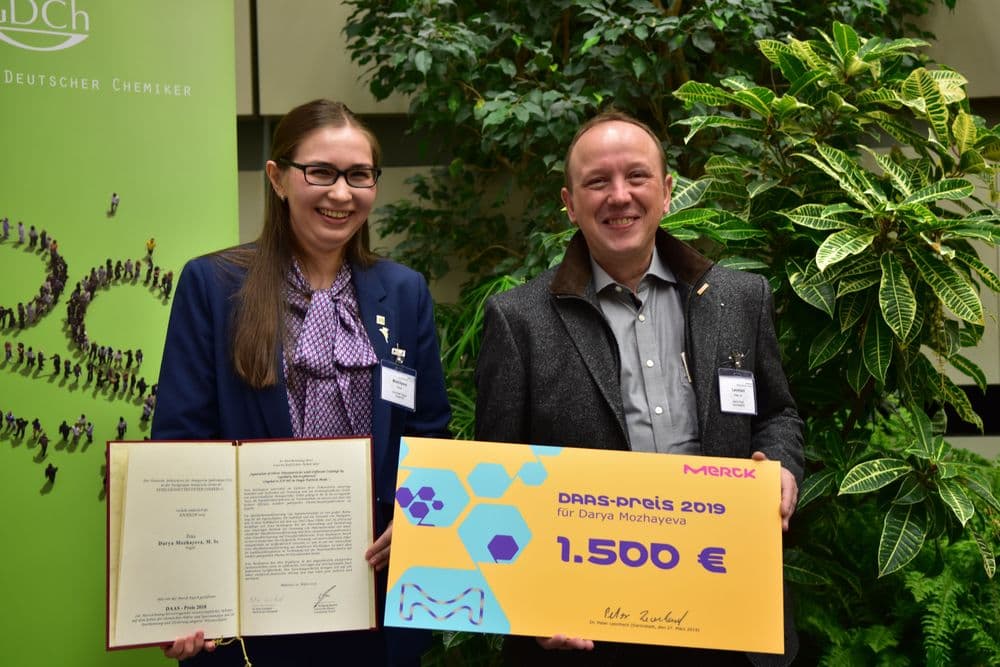
Presentation of the DAAS Prize on the occasion of ANAKON 2019 in Münster to Darya Mozhayeva (left) by Dr. Peter Leonhard (right).
Photo: University of Münster
| Year | Awardee, location* | Citation |
|---|---|---|
| 2025** | Dr. Andrea Teuber, Ulm | in recognition of her dissertation entitled "Advanced Quantum Cascade Laser Infrared Attenuated Total Reflection Spectroscopy", completed under the supervision of Prof. Dr. Boris Mizaikoff at Ulm University |
| 2022 | Dr. Carla Kirschbaum, Berlin | in recognition of her dissertation entitled "Lipid Fingerprinting by Mass Spectrometry and Laser Light", completed under the supervision of Prof. Dr. Kevin Pagel at Freie Universität Berlin and the Fritz Haber Institute of the Max Planck Society |
| 2020 | Dr. Gerrit Renner, Essen | in recognition of his dissertation entitled "Development of new spectroscopic and multivariate chemometric methods for the characterization of microplastics in the marine environment", completed in the working group of Prof. Dr. Torsten C. Schmidt at the University of Duisburg-Essen |
| 2018 | Darya Mozhayeva, Siegen | in recognition of her scientific work on “Separation of Silver Nanoparticles with Different Coatings by Capillary Electrophoresis Coupled to ICP-MS in Single Particle Mode” |
| 2016 | Dr. Ann-Christin Niehoff, Duisburg | in recognition of her scientific work on “Elemental and Molecular Mass Spectrometry for Complementary Bioimaging: From Method Development to Biomedical Applications" |
| 2014 | Dr. Olga Borovinskaya, Thun / Switzerland | in recognition of her scientific work on “A new inductively coupled plasma time-of-flight mass spectrometer: Fundamental studies and applications” |
*at the time of the award
**Adjustment of the award year to the year of presentation.
| Year | Awardee (institution at the time of the award) | Reason |
|---|---|---|
| 2012 | Dr. Marlies Grebe, Helmholtz Centre, Geesthacht | in recognition of her scientific work on the “Isolation and characterisation of transferrin glycoforms from blood samples of seals” |
| 2010 | Jessica Köster, Leibniz Institute for Analytical Sciences, ISAS, Dortmund | in recognition of her scientific work on the “Isoelectric focusing of small, non-covalently bound metal species from plants” |
| 2008 | Dr. Jens Heilmann, Johannes Gutenberg University Mainz | in recognition of his scientific work on the “Development of mass-spectrometric isotope dilution techniques for the reliable determination of trace elements and sulphur species in petroleum products |
| 2006 | Dr. Carsten Engelhard, University of Münster | in recognition of his scientific work on “A new plasma source for trace analysis – development, characterisation and application of inductively coupled plasma with reduced gas flow |
| 2004 | Dr. Anastasia Schwarz, Johannes Gutenberg University Mainz | in recognition of her scientific work on the “Development of an online coupling method of GC with ECD and ICP-MS detection for the determination of biogenic volatile brominated and iodinated hydrocarbons in seawater and the atmosphere |
| 2002 | Dr. Heiko Reinhardt | in recognition of his scientific work on the “Development and application of a laser ablation ICP-MS method for the multi-element analysis of atmospheric deposits in ice cores”.in recognition of his scientific work on the “Development and application of a laser ablation ICP-MS method for the multi-element analysis of atmospheric deposits in ice cores |
| 2000 | Dr. Uwe Schäffer | in recognition of his scientific work on the “Development and application of direct spectrometric methods for the analysis of carbon-based high-tech materials |
| 1998 | Dr. Michael Schwarzer | in recognition of his scientific work on the “Selective enrichment and determination of palladium in the ng and pg/L range by coupling a novel flow injection method with highly sensitive instrumental analytical techniques |
| 1996 | Dr. Jörg Bettmer, University of Münster | in recognition of his scientific work on the “Development of atomic spectrometric analytical methods for the speciation of lead and mercury |
| Dr. Heinrich Kipphardt | in recognition of his scientific work on the “Coupling of digestion with elemental fluorine and gas mass spectrometry | |
| 1994 | Dr. Dietrich Volmer | in recognition of his scientific work on the “Determination and structural characterisation of plant protection products by coupling liquid chromatography and mass spectrometry |
| 1992 | Dipl.-Chem. Dirk Wallschläger | in recognition of his scientific work on the “Development of a method for the enrichment and determination of trace vinyl chloride and dichloroethenes in water |
| 1990 | Dr. Walter Drews | in recognition of his scientific work on the “Development of a universal, extremely sensitive nickel determination method (pg/g range) using MIP-OES or AAS after volatilisation as nickel tetracarbonyl |
| 1988 | Dr. Heinrich Baumann | in recognition of his scientific work on the “Investigation of bromine/lead ratios as well as organically bound halogen and lead compounds in aerosols and vehicle exhaust gases |
| 1986 | Dr. Barbara Wiecken | in recognition of her scientific work on “Trace analytical investigations into heavy metal contamination of lung tissue |