
Hess biography
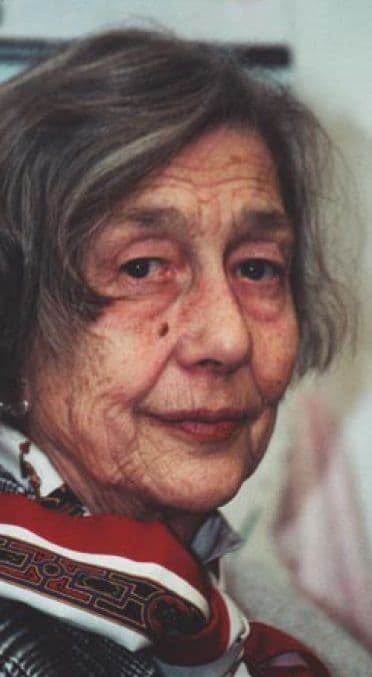
Hildegard Hess followed in her father’s footsteps. While still working on her doctoral thesis at Technische Universität Berlin, she worked in his analytical laboratory. She eventually took it over and ran it for three decades.
Hildegard Hess was born in 1920 in the Berlin district of Britz. Her father, Ludwig Hess (1882–1956), was director of a factory belonging to the chemical company Riedel de Haën, while her mother Hertha was a trained nurse. As the family lived in accommodation on the factory premises at the time, Hess came into contact with chemistry at an early age. In 1931, her father took over a chemical testing laboratory as a state-certified food and commercial chemist.
Hess attended a convent school and was therefore exempt from membership of the League of German Girls. She passed her Abitur in 1939 – shortly before the school was closed by the National Socialists. She then began studying chemistry at the Friedrich Wilhelm University in Berlin, but soon moved to the Albert Ludwig University of Freiburg. She completed her training in 1944 at the Berlin Reich Institute for Food Chemistry and Pharmaceutical Chemistry. Her academic teachers included the future Nobel laureates in Chemistry Hermann Staudinger (1881–1965) and Georg Wittig (1897–1987). “It was actually under Professor Wittig that I first understood chemistry,” Hess said in retrospect. With his ability to inspire, he had been her most wonderful teacher.
After her examinations, Hess joined her father’s commercial laboratory. Alongside this work, she completed her doctorate under Josef Schormüller (1903–1974) at the Institute of Food Chemistry at Technische Universität Berlin, researching the vitamin content of the mycelium of microorganisms. She was awarded her doctorate in 1953. A year later, she was publicly appointed and sworn in as a commercial chemist. This enabled Hess to work as a consultant and expert for manufacturers and the trade in the chemical sector. In Berlin, and possibly even throughout Germany, she was the first woman to hold this position.
After her father’s death in 1956, Hess took over his commercial laboratory and ran it for three decades. In 1986, the laboratory merged with Institut Kirchhoff Berlin, a service company for analysis founded three years earlier, which still exists today.
Alongside her work as a self-employed chemist, Hess taught at TU Berlin, where she held a teaching post in nutritional sciences from 1955 to 1965. She also ran courses for food retailers. Hildegard Hess died in Berlin on 23 July 2014 at the age of 84.
Literature
German Chemical Society (GDCh): Women chemists – they existed and they exist, 2003, p. 26
G. Boeck, Nachrichten aus der Chemie 51, 2003, p. 67
Authors
Prof. Dr. Eberhard Ehlers
Prof. Dr. Heribert Offermanns
Editorial work
Dr. Uta Neubauer
Project management
Dr. Karin J. Schmitz (GDCh-public relations)
The authors are responsible for the content of the biographies.
The content presented on these pages has been compiled with care. Nevertheless, the authors, Editorial staff and publisher accept no responsibility or liability for the completeness and accuracy of the content or for typographical errors.