
Biography of Dane
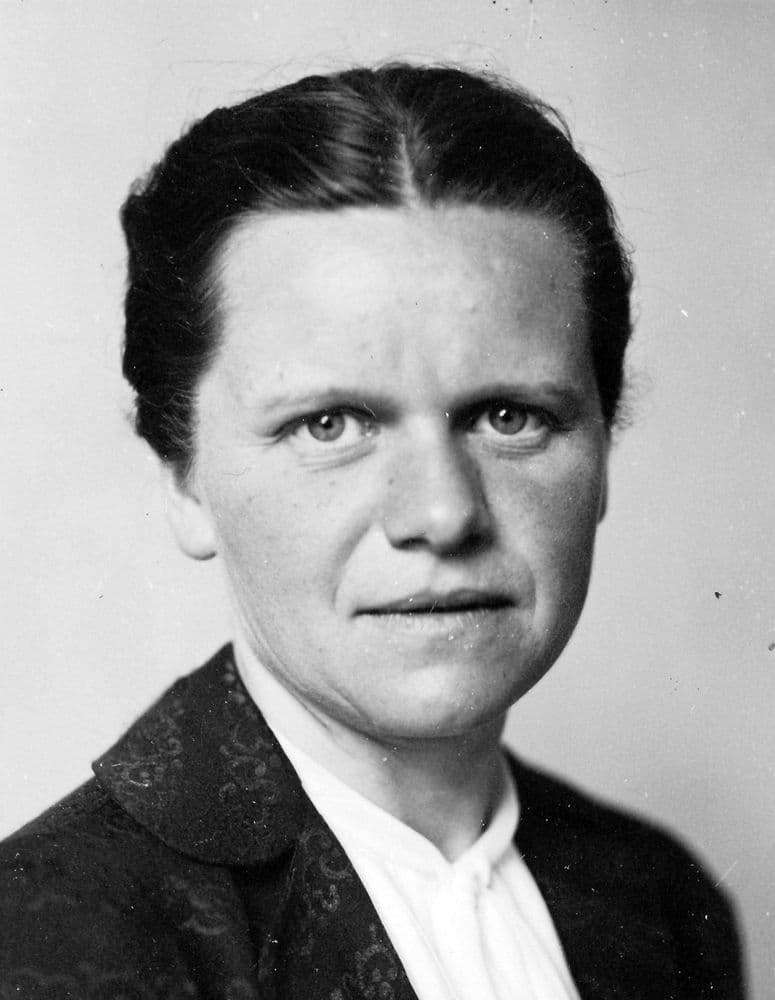
Elisabeth Dane, born in Mayen in 1903, pursued an extraordinary career at Ludwig Maximilian University of Munich (LMU): she completed her doctorate at the age of 26 despite studying at various universities, obtained her habilitation and Venia Legendi at 31, led her own working group, published in Angewandte Chemie, gave lectures and worked on the Editorial staff of Liebigs Annalen der Chemie. Heinrich Wieland (1877–1957), her mentor since her second Verbandsexamen in 1927, wrote when her habilitation was pending in 1933: “Miss Dane … is one of the most gifted of the students I have trained to date. She possesses an independence and precision of scientific thought such as I have not previously encountered in women, ... I am in principle of the opinion that women should only be recruited for academic work in exceptional cases, but such an exceptional case exists here.”
This was followed by 35 years as a private lecturer and Professor of Organic Chemistry (1939–1968) at the LMU; for 30 years she was responsible for the chemistry training of medical students. She was the first female professor of chemistry in Munich and one of the first at the LMU. Elisabeth Dane led her own working group and was the first bestselling author of the GDCh-Verlag-Chemie publishing house; in 1998, a street in Munich was named after her. And yet hardly anyone in chemistry knows her name today.
How does something like this happen? One reason is certainly that none of the authors of the biographies of female chemists written to date (t1p.de/p9v0z) studied at the LMU Munich; quite simply, there were no personal connections.
When one researches the lives and careers of the pioneering women, patterns emerge. In the first phase, a strong, above-average interest in the natural sciences and the openness of an educated family environment are important. Then male (!) mentors and the development of internal and external networks come into play. In the second career phase, it is important to continue to “keep up” with research and to take up new methods and theories together with a committed working group. As a lone fighter with many tasks outside research, one falls behind. Things initially went very well for Elisabeth Dane: Heinrich Wieland, winner of the 1927 Nobel Prize, recognised her abilities; she published outstanding work with him and independently on the synthesis and structural elucidation of complex natural products. He involved her as a private assistant in many projects, encouraged independent research and entrusted her with the highly important training of medical students in chemistry.
But then the second wartime period already began for Elisabeth Dane’s mentor Heinrich Wieland. In 1942, his 65th birthday was celebrated; Elisabeth Dane was 39 years old, unmarried and the only woman among his large cohort of students. Her colleague Franz Wille (1909–1986), who was six years younger, wrote about this period, and about Elisabeth Dane in particular, when looking back on his 70th birthday:
"Miss Dane ruled the ground floor. She was the chief’s mouthpiece. Difficult matters concerning the institute always had to be discussed with her before being presented to the chief. We lecturers hardly ever visited one another in those days. But one day Miss Dane did come; I will never forget it. It was half past seven in the morning; she rang the bell and immediately stormed in: „Wille, you don’t need to get up and go to the institute. It’s been destroyed.“ That was in December 1944."
The institute was completely destroyed, the laboratories were moved to other locations, and research and training were maintained as best as possible – everyone travelled long distances by bicycle and on the few trains available in order to communicate with one another. While all the male lecturers were dismissed after the end of the war, Elisabeth Dane, who was not a member of the NSDAP, received permission from the military government on 18 December 1945 “to continue research work in the field of vitamin A”. Yet she had little time for this. Her mentor and head of the institute, whose health was failing, commissioned Elisabeth Dane and his exceptionally gifted “junior student”, Rolf Huisgen (1920–2020), who was 17 years younger, to organise the institute’s key tasks, the practical course for medical students and the reconstruction of organic chemistry. Elisabeth Dane was Heinrich Wieland’s only constant in the post-war years. In 1948, former colleagues were reinstated, and Rolf Huisgen was appointed to Tübingen in 1949. Elisabeth Dane also received an offer in 1948/1949 – to Rostock; but she declined without (!) demanding negotiations to retain her, as she did not want to leave “her medical students and her mentor and colleague Heinrich Wieland” alone during the reconstruction. Finding a successor for Wieland was not easy, partly because the institute had been completely destroyed. Several of his students declined; Elisabeth Dane was evidently not considered suitable for the role, and so Rolf Huisgen was finally appointed in 1952. Elisabeth Dane had just turned 50.
Elisabeth Dane had too little time for research and to catch up with the new, theory-driven international organic chemistry. She successfully researched the still young field of peptide chemistry in pharmaceutical chemistry and may have been somewhat ahead of her time. Organising the training of 450 medical students, who were not particularly interested in chemistry, with 15 frequently changing assistants, together with the oral examination customary at the time, was a Herculean task. Elisabeth Dane became known throughout West Germany for this, not least thanks to the book “Kleines chemisches Praktikum”, published in 1960 and still available today, which she had written with Franz Wille and regularly updated; more than 400 easily reproducible experiments combined with brief theoretical texts made the work, and thus her name, well known.
In the 1960s, Elisabeth Dane began publishing in Angewandte Chemie again and attended international peptide conferences in Oxford and Athens. By then, however, these were primarily being organised by biochemistry institutes; Elisabeth Dane had remained at the organic institute because of the medical training based there. This did not promote Elisabeth Dane’s scientific networking. In 1965, a heart attack forced her to take an extended break and curbed her enthusiasm for research, though not her passion for cigarettes. She would have liked to continue working at the institute beyond retirement age, but her application was rejected. She therefore withdrew to her self-built and self-designed house in Gauting, far outside Munich city centre. She declined celebrations for milestone birthdays and, at her own request, was buried quietly in March 1984 after a long illness, having been cared for by her sister.
In his 2023 work on the history of the Faculty of Chemistry at the LMU, Wolfgang Beck writes about Elisabeth Dane’s contemporaries: “Friedrich Klages (also a Wieland student) belonged to a generation that was passed over when chairs were filled as a result of the turmoil of war and the post-war period. This also applies to Elisabeth Dane, Hans Behringer, Rudolf Hüttl and Franz Wille.”
Perhaps a quota would have helped her career. Her path shows how important it is “that the chemistry is right” – again and again.
This article appeared in "Nachrichten aus der Chemie", May 2025
Author: Dr. Eva E. Wille, Chair of the Division of Senior Expert Chemists