
Weyde biography
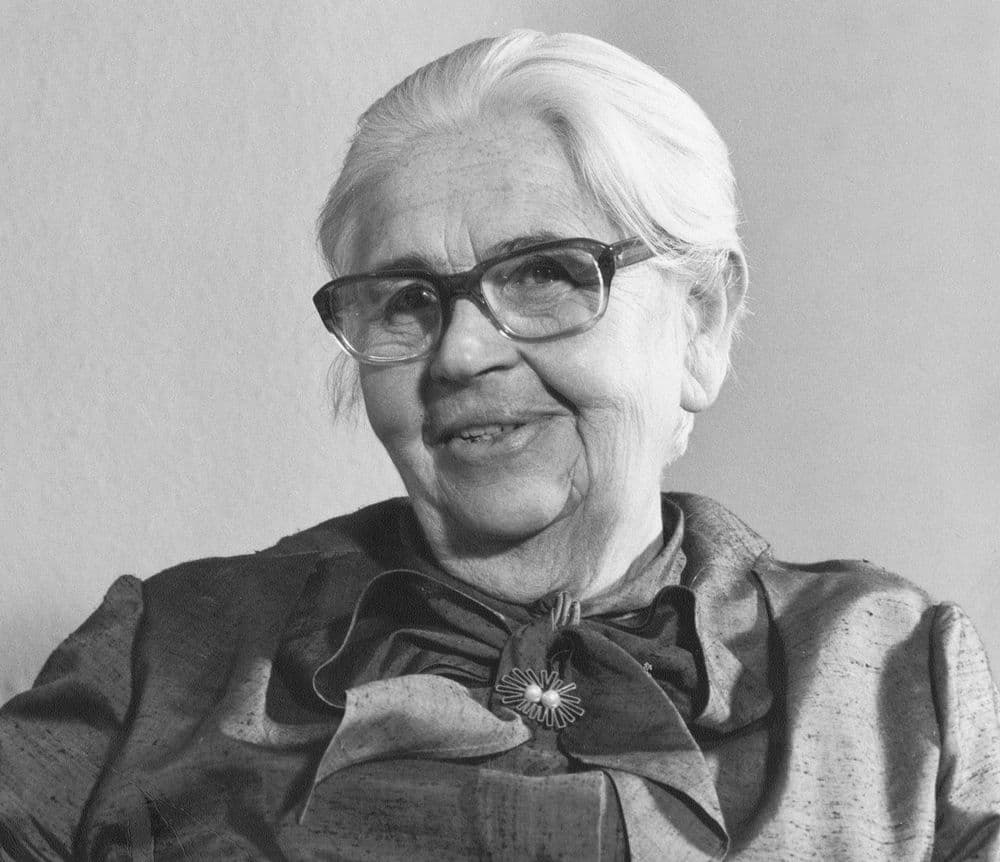
As a child, she experimented in her grandfather’s laboratory; as a chemist, Edith Weyde pursued a career at the Actien-Gesellschaft für Anilin-Fabrication, known as Agfa for short. She developed stabilisers for photographic paper and invented the first photocopying technique.
Edith Weyde was born in Prague on 17 September 1901 and grew up in Aussig on the Elbe in northern Bohemia. Her father came from Austria and was a secondary-school teacher. Her grandfather, who had studied botany, zoology and chemistry, owned a laboratory that awakened his granddaughter’s interest in scientific experimentation at an early age.
Although Weyde obtained her university entrance qualification on completing her Abitur in 1919, she did not immediately begin studying chemistry—probably for financial reasons—but initially worked for four years as a laboratory assistant at the Österreichischer Verein für chemische und metallurgische Produktion, an industrial company in Aussig.
It was not until 1923 that Weyde began studying chemistry at Dresden University of Technology. After just four years, she completed her dissertation on “New Materials for X-ray Screens” and was awarded a doctorate in engineering. Her doctoral supervisor was the chemist Robert Luther (1867–1945), founder and director of the Photographic Institute at Dresden University of Technology, where he was professor of physical chemistry. Before Luther was appointed to the chair in Dresden, he had spent many years conducting research in Leipzig as an assistant to Nobel Prize-winning chemist Wilhelm Ostwald (1853–1932).
On the recommendation of her doctoral supervisor, Weyde took a position in the photographic-photochemical laboratory of IG Farben in Oppau near Ludwigshafen in 1928. In 1932, she moved to the Actien-Gesellschaft für Anilin-Fabrication, known as Agfa for short, in Leverkusen. This was where her professional and scientific career really took off.
One of Weyde’s first tasks at Agfa was to optimise photographic paper so that it could be processed and stored more effectively in warm, humid conditions. She developed stabilisers for the photographic layers, making the papers suitable for use in tropical climates. Weyde was also involved in developing the first Agfacolor papers for colour photography. Her responsibilities also included materials testing and assessing customer complaints. The careful examination of complaints and intensive investigation into their causes eventually led to her most important discovery: the previously unknown diffusion of silver salt in the photographic layers. This undesirable process impaired the quality of photographs and was therefore responsible for numerous customer complaints.
In the traditional development process, a negative was first produced, from which the positive—the actual photograph—was created in the next step. The photographic prints were transferred in batches from the developer bath to the fixing bath. Weyde recognised that unexposed image silver separated from the developer-moist prints, diffused into the back of the layer adhering above it and was fixed there. This resulted in blurred negatives and unsightly spots on the otherwise light-coloured backs of the photographs.
The discovery of silver-salt diffusion gave Weyde the idea for a new technique that developed the negative and positive simultaneously, resulting in enormous time savings when making copies. The technique was ideal for rapidly reproducing important documents, for example in everyday office work, where the time-consuming photographic process was unsuitable. Weyde developed the idea to market readiness.
On 25 January 1942, Agfa was granted the patent for Weyde’s “Process for the accelerated production of a photographic positive image from an original”. However, because of the Second World War, the technique, known as Copyrapid, did not come onto the market until 1949. Immediately after the currency reform in 1948, Agfa invited all known German manufacturers of photographic products to design an office-suitable photocopier based on Weyde’s invention. Walter Eisbein, co-owner of the Stuttgart company Trikop, needed only eight weeks to do so. His device, called Develop (English for develop), exceeded all expectations. Following the presentation of the novel photocopying process, the name “Blitzkopie”, used by the manufacturers and inventors, became established.
Blitzkopie was an immediate success and also conquered other European countries. The copying method entered the US market in 1952. As with many innovations, parallel developments took place. By the end of the 1970s, the diffusion copying process had been displaced by new techniques such as the Xerox process. Ultimately, however, we owe it to the chemist Weyde and her inventive spirit that copying written material and other documents is so commonplace today.
Edith Weyde died on 10 February 1989 in Kürten, a municipality in North Rhine-Westphalia. Although her ingenious achievements are largely unknown to the general public, Weyde received several awards in specialist circles. One of the most important honours was the Cultural Prize of the German Society for Photography, which was awarded to her in 1963.
Literature
German Chemical Society (GDCh): Women chemists – they existed and still exist, brochure 2003, p. 20
K. Urbons, J. Ehlen (editors): Edith Weyde – How an Inventor from the Rhineland Changed the World, Edition Makroskope, Mülheim an der Ruhr, 2016
Authors
Prof. Dr. Eberhard Ehlers
Prof. Dr. Heribert Offermanns
Editorial work
Dr. Uta Neubauer
Project management
Dr. Karin J. Schmitz (GDCh-public relations)
The authors are responsible for the content of the biographies.
The content presented on these pages has been compiled with care. Nevertheless, the authors, Editorial staff and publishers accept no responsibility or liability for the completeness and accuracy of the content or for typographical errors.