
Biography Pfannemüller
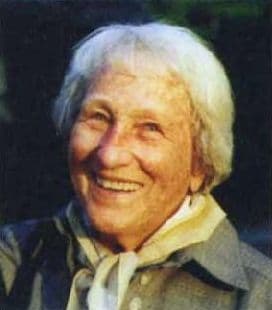
From the beginning of her doctoral research until her retirement, Beate Pfannemüller conducted research at the Institute of Macromolecular Chemistry at the University of Freiburg. She led a large working group, but particularly at the beginning of her scientific career, she stood in the shadow of Nobel laureate Hermann Staudinger.
Beate Pfannemüller (née Beuteführ) was born in Wiesbaden on 6 September 1920. After marrying tropical medicine specialist Ludwig Pfannemüller (1915–2008), she adopted his surname.
Pfannemüller passed her Abitur in Berlin in 1939 and, after completing the Reich Labour Service, received a scholarship to study in the USA. As she was unable to begin her studies abroad because of the Second World War, she studied chemistry in Berlin. She completed her studies in 1944 with a dissertation on carbodiimides under Alfred Zetzsche.
In 1946, Pfannemüller began her doctoral research under Elfriede Husemann (1908–1975) at the Institute of Macromolecular Chemistry at the University of Freiburg. The subject of her dissertation was the sulphation of xylans, the second most common natural polysaccharides. Like her doctoral supervisor, Pfannemüller remained in the shadow of Nobel laureate Hermann Staudinger (1881–1965), the founder of modern polymer chemistry, who taught and conducted research in Freiburg until 1956.
After successfully completing her doctorate, Pfannemüller remained at the Freiburg institute until her retirement in 1985, where she led a large working group. She became an expert in polysaccharide research, focusing on starch chemistry. For her achievements in this field, she received the Saare Medal in 1988, an award presented by the Cereal Research Working Group.
Beate Pfannemüller died in Freiburg im Breisgau on 18 October 2008.
Literature
Kürschners Deutscher Gelehrten-Kalender, Walter de Gruyter, Berlin and New York, 12th edition, 1976, volume 1, p. 1373 and 14th edition, 1983, volume 3, p. 4830
P. Mischnick, Nachrichten aus der Chemie 53, 2005, p. 1076
Authors
Prof. Dr. Eberhard Ehlers
Prof. Dr. Heribert Offermanns
Editorial work
Dr. Uta Neubauer
Project management
Dr. Karin J. Schmitz (GDCh-public relations)
The authors are responsible for the content of the biographies.
The content presented on these pages has been prepared with care. Nevertheless, the authors, editorial staff and publisher accept no responsibility or liability for the completeness and accuracy of the content or for typographical errors.