
Klemer biography
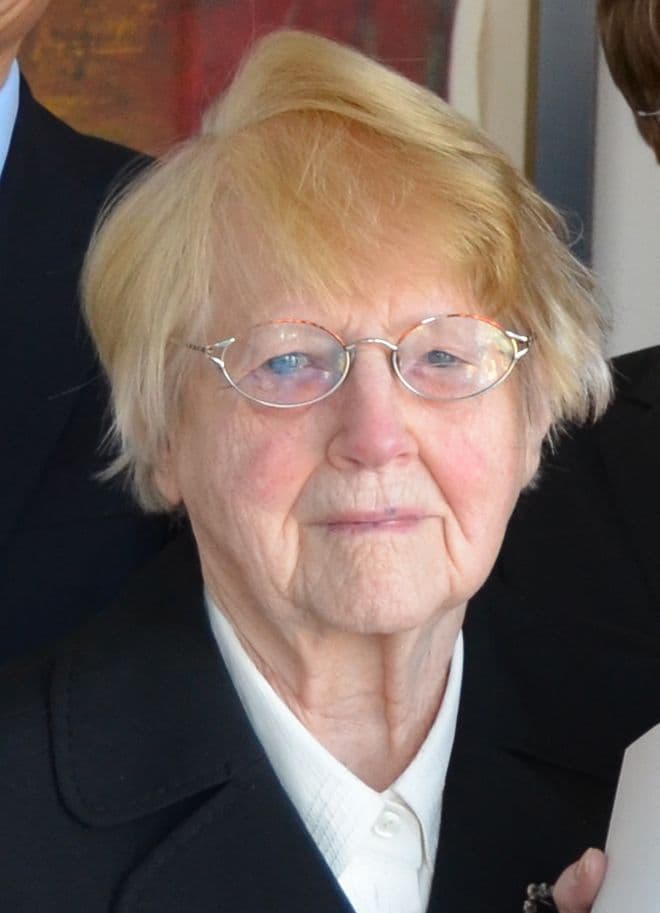
Almuth Klemer was the first woman to habilitate in chemistry at the University of Münster. Grateful for her successful academic career, she established a foundation in her old age to support chemistry students and children from disadvantaged backgrounds.
Almuth Klemer was born on 12 February 1924 in the small Lower Saxon town of Bassum. Even as a girl, she was interested in the natural sciences – an inclination her parents encouraged. Klemer passed her Abitur in February 1942. Two months later, however, she had to spend a year in the labour service. Only then was she able to begin studying chemistry at Justus Liebig University Gießen.
It soon became impossible to maintain an orderly teaching and study routine in Gießen. The city was almost completely destroyed by heavy air raids in 1944, and the university dissolved at the end of the war. In the turmoil of the final days of the war, Klemer managed to return home. To support herself, she initially worked in a steelworks. At the same time, she attended courses offered to returning soldiers to improve her knowledge of physics and mathematics. For the winter semester of 1945/46, she received the long-awaited notice of admission to study physics, mathematics and chemistry at the University of Münster (WWU) – though, under the professional supervision criteria for women, only as a teacher-training student.
Klemer is described by her fellow students as sociable, enthusiastic and a good team player. She coped perfectly well with the modest, almost meagre facilities in the laboratories, and during evening conversations she convinced her academic teachers of her aptitude for the natural sciences. The professors soon supported her move from teacher training to “full chemistry” at WWU. After her diploma examination in 1950, she immediately began her doctoral thesis, entitled “On the synthesis of sugar–amino acid compounds and a new method for the preparation of sugar anhydrides”. Klemer received her doctorate in 1952. Her doctoral supervisor was Fritz Micheel (1900–1982), who headed WWU’s Institute of Organic Chemistry from 1937 to 1968 and played a decisive role in rebuilding organic chemistry in Münster after the war.
From then on, Klemer focused her research on the synthesis and degradation of sugar molecules. In 1958, she became the first woman to habilitate in chemistry at WWU. She published excerpts from her habilitation thesis under the title “Synthesis of a trisaccharide with a branched structure (4-α,6-β-bis-D-glucosido-D-glucose)”. She remained loyal to the University of Münster throughout her research career: she was appointed scientific councillor there in 1963, extraordinary professor the following year, and finally professor of organic chemistry in 1980. For almost thirty years, until 1986, Klemer taught and conducted research as a professor at WWU. During this time, she supervised 54 doctoral students.
In addition to almost 100 scientific publications, Klemer wrote numerous textbooks and research reports on carbohydrate chemistry, both as sole author and co-author. She also took a keen interest in the position of women in science and wrote a noteworthy monograph on the subject as early as the late 1960s. She experienced at first hand the downsides of a life devoted to science: she never married and had no children.
In recognition of her scientific and social commitment, Klemer was awarded the Order of Merit of the Federal Republic of Germany on ribbon in 1970. From 2014, she used the Almuth Klemer Foundation to support education, science and research in her field, including by awarding the Almuth Klemer Scholarship to chemistry students at WWU. Klemer also supported schoolchildren in need from the district of Göttingen with her personal wealth. “I am grateful for a successful professional life, which would not have been possible without a scholarship and support from the Chemical Industry Fund,” she emphasised. She wanted to give something back by establishing her foundation: “I think it is important to encourage talent through incentives to achieve.”
Almuth Klemer died in November 2022 at the age of 98.
Literature

December 2014: Presentation of the certificate of recognition to the founder (second from left) by the Regierungspräsident Prof. Dr Reinhard Klenke (right), in the presence of the Rector of WWU Prof. Dr Ursula Nelles (third from left) and the foundation’s board member Prof. Dr Armido Studer (left).
Authors
Prof. Dr. Eberhard Ehlers
Prof. Dr. Heribert Offermanns
Editorial work
Dr. Uta Neubauer
Project management
Dr. Karin J. Schmitz (GDCh-public relations)
The authors are responsible for the content of the biographies.
The content presented on these pages has been carefully prepared. Nevertheless, the authors, Editorial staff and publisher accept no responsibility or liability for the completeness and accuracy of the content or for typographical errors.