
Pockels biography
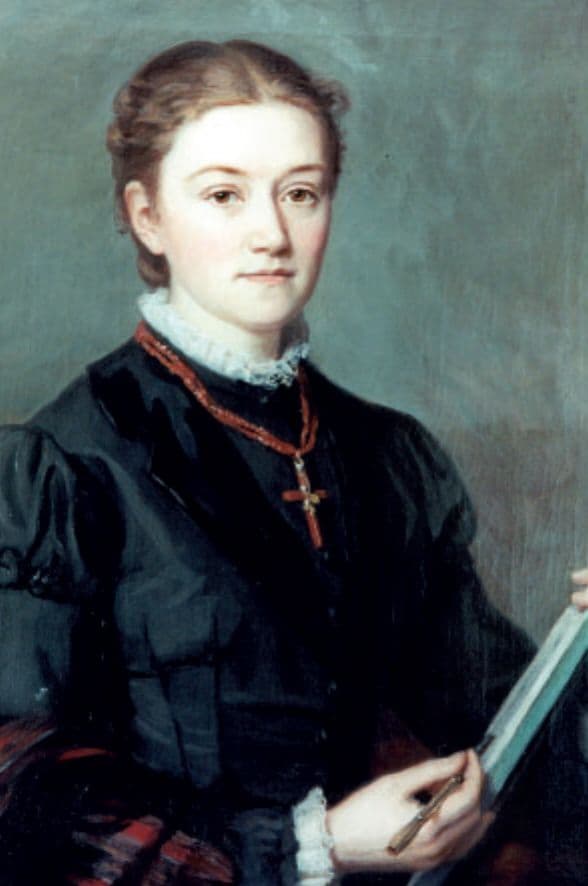
She was a self-taught woman who learned from her brother’s books and investigated the surface tension of liquids while washing the dishes. The British scientist Lord Rayleigh helped Agnes Pockels achieve her breakthrough. Eventually, she was allowed to conduct research at the Technical University of Braunschweig.
Agnes Luise Pockels was born on 14 February 1862 in Venice, the daughter of Alwine and Theodor Pockels, an Austrian professional officer. Her brother Fritz was born three years later in Vicenza. The malaria that was widespread in the region at the time did not spare the Pockels family either and eventually led to her father’s early retirement.
In 1871, the family moved to Braunschweig, where Pockels attended the municipal higher school for girls. The young woman gave up the opportunity to study in order to care for her ailing parents. Nevertheless, using the physics textbooks belonging to her brother, who later became a professor of physics, she developed into a self-taught scientist and made significant observations on the surface tension of liquids – virtually while doing the daily washing-up. In 1882, she invented the trough with movable partition, still used today to investigate the phenomenon. The US researcher Irving Langmuir (1881–1957) subsequently developed it into the Langmuir–Pockels film balance. Langmuir received the Nobel Prize in 1932 – some of his findings were based on Pockels’ experiments.
Pockels made an important contribution to elucidating interfacial phenomena. As a scientific outsider, she feared that German journals would reject a publication by her, so in 1891 she contacted the English physicist and later Nobel Prize winner John William Strutt (1842–1919), known as Lord Rayleigh. A lively correspondence developed, and Pockels’ work was eventually published in the journal “Nature” on Rayleigh’s recommendation. This also made Pockels known in Braunschweig. From then on, she was allowed to work at the physics institute of the Technical University of Braunschweig and was also invited to give scientific lectures. On 27 January 1932, Pockels became the first and, to date, only woman to receive an honorary doctorate from the Technical University of Braunschweig for her groundbreaking research into surface chemistry – an extraordinary honour for a self-taught scientist.
Agnes Pockels died in Braunschweig on 21 November 1935 at the age of 73. Since 1993, the Technical University of Braunschweig, as the institution is now called, has awarded the Agnes Pockels Medal to people who have made an exceptional contribution to promoting women in research and teaching.
Literature
• Arbeitskreis Andere Geschichte (editor): Braunschweiger Frauen. Gestern und heute. Sechs Spaziergänge, Braunschweig, 2002, p. 111
• G. Beiswanger, Chemie in unserer Zeit 1991, 25, p. 97
• G. Beiswanger: Pockels, Agnes Luise Wilhelmine. In: Neue Deutsche Biographie, vol. 20, p. 55, Duncker & Humblot, Berlin, 2001
• German Chemical Society (GDCh): Women chemists – they existed and still do, brochure 2003, p. 8
Authors
Prof. Dr. Eberhard Ehlers
Prof. Dr. Heribert Offermanns
Editorial work
Dr. Uta Neubauer
Project management
Dr. Karin J. Schmitz (GDCh-public relations)
The authors are responsible for the content of the biographies.
The content presented on these pages has been carefully prepared. Nevertheless, the authors, Editorial staff and publisher accept no responsibility or liability for the completeness and accuracy of the content or for typographical errors.