
Sandner biography
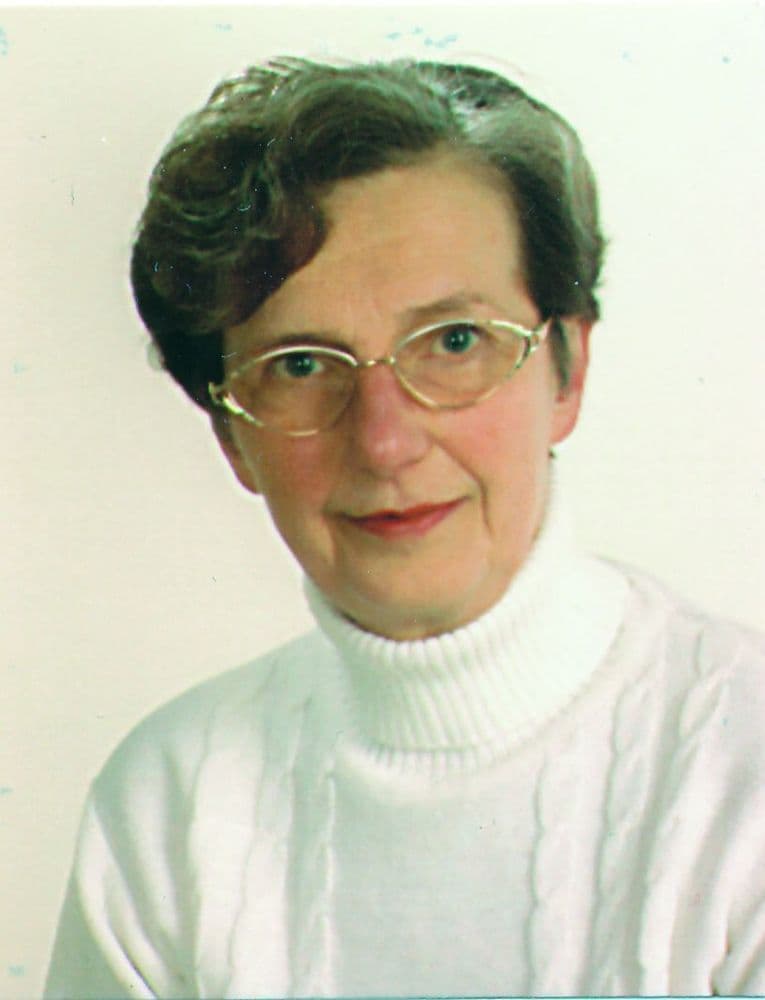
Barbara Sandner (née Meinke, born 1937) comes from Stralsund. There, she attended primary school up to Year 8 in 1952 and secondary school until completing her Abitur in 1956. From Year 7 onwards, Barbara’s chemistry teacher awakened her interest in the subject. Her parents, who worked in commercial professions, supported this and bought her a chemistry textbook used for training laboratory technicians and skilled chemical workers at vocational schools – textbooks for primary and secondary schools were not available in the post-war period.
At secondary school, the chemistry teacher offered an after-school working group with opportunities to conduct experiments, which Barbara joined. It is therefore unsurprising that she – the only person in her year – applied to study chemistry, specifically at Humboldt University Berlin. She was rejected because her political views, reflected in grades of 3 in history and civics, in contrast to the grades of 1 and 2 in all other subjects, raised doubts.
She submitted her second application to the Technical University for Chemistry Leuna-Merseburg, founded on 1 September 1954. Representatives of the university came to Rostock for the admissions interview, which was successful. Barbara began her studies in Merseburg in October 1956.
After passing her intermediate diploma examination and completing her basic studies, her main interest turned to polymer chemistry. She attended an introductory lecture and the lecture “Chemical Fibre Materials”, the latter given by Hermann Klare (1909–2003). He was Deputy Director of the Institute for Fibre Research of the Academy of Sciences in Teltow-Seehof. Supervised by Joachim Ulbricht (1924–2017), Barbara completed her dissertation there in 1960/61, having heard only positive reports from other students.
After her work had been accepted and she had passed her diploma examination, she obtained a doctoral position as a research assistant at the institute in Teltow-Seehof. In Ulbricht’s working group, she completed her dissertation, “The Influence of Impurities on the Solution Polymerisation of Acrylonitrile, with Particular Consideration of Unsaturated Compounds”. She submitted it to the TH Merseburg in 1965 and defended it there at the end of 1965.
During her doctoral studies, she met and married her husband, who was also a chemist. Their daughter was born in 1964. Because there were not enough nursery and kindergarten places in the 1960s, the grandmother came to Teltow to look after the baby. The Sandners were not given the larger flat they needed for this purpose, and the grandmother was not granted a residence permit in Teltow.
The housing problem was resolved in 1965 by an offer from the Premnitz Chemical Fibre Works (CFW). Barbara Sandner’s husband had already accepted a position as a research associate at the CFW in August 1965. In December 1965, the family, including the grandmother, were able to move into a flat in Premnitz.
From 1966, Barbara Sandner first worked as a research associate and then as head of a section for scientific and technical information (WTI) in the research and development (R&D) division. At the end of 1967, she took over management of the Central Laboratory and WTI department and, from May 1970, was Deputy Director of R&D. In 1969, she obtained a kindergarten place for her daughter.
Further blows of fate followed: her husband died in a car accident in 1970, and her grandmother and mother-in-law died in 1971. The following year, Barbara Sandner returned as a research associate to what was now the Institute of Polymer Chemistry of the Academy of Sciences in Teltow-Seehof. She investigated the influence of complex formation and the reaction medium on the copolymerisation of acrylonitrile and styrene. Her results were so exceptional that she received the Friedrich Wöhler Award. This was a scientific award for outstanding achievements by young scientists at the start of their careers. Only two women received it between 1960 and 1991. The research findings were submitted and defended in 1979 for the Dr sc nat qualification. Barbara Sandner received her Facultas docendi from TU Dresden in 1980.
In 1983, she was appointed university lecturer at the TH Merseburg. She expanded her fields of work to include medical composite materials and solid polymer electrolytes. In 1988, together with dentists from the Erfurt Medical Academy, she received the Rudolph Virchow Award for a dental composite that they had jointly developed and tested.
In September 1989, she was appointed extraordinary professor in Merseburg. However, the first Higher Education Structural Act of the state of Saxony-Anhalt, dated 28 February 1992, stipulated that the TH had to be legally dissolved by 31 March 1993. The three highest-performing divisions, including chemistry, had already been merged with Martin Luther University Halle-Wittenberg. The scientific achievements of Barbara Sandner, who was not a party member, were fully recognised; her Dr sc nat qualification was converted into a habilitation, and Sandner was appointed Professor of macromolecular chemistry at the University of Halle-Wittenberg.
After her retirement in 2002, Barbara Sandner continued to work independently on a research project, supervising a doctoral student and a research associate until 2004.
This article appeared in “Nachrichten aus der Chemie”, May 2025
Author: Dr. Gisela Boeck, Chair of the Division of history of chemistry