
Biography Holzapfel
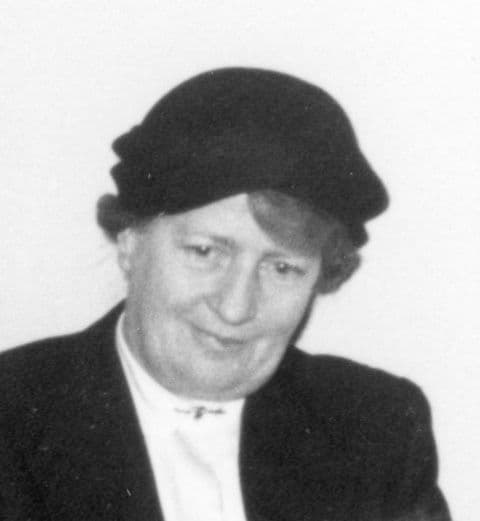
Her scientific career began at the Kaiser Wilhelm Institute for Silicate Research and ended with early retirement. Luise Holzapfel researched organic silicic acid compounds as well as the dust-induced lung disease silicosis.
Luise Holzapfel was born on 14 March 1900 in Höxter on the Weser and grew up in a comfortably well-off family of lawyers. Her father, Wilhelm Holzapfel, was a senior government official; her mother, Elsa, did not pursue a profession. Holzapfel did not take her Abitur, unusual for young women at the time, until she was 29, at an evening grammar school in Berlin. From 1929 to 1934, she studied chemistry, physics, technology and economics at the Friedrich Wilhelm University of Berlin. In October 1936, she became the first woman to receive a doctorate at the new Faculty of Mathematics and Natural Sciences. Her doctoral thesis was entitled “On the Photochemical Combustion of Carbon Monoxide”.
In 1939, Holzapfel took up a position as a research assistant at the Kaiser Wilhelm Institute for Silicate Research in Berlin-Dahlem. There, she completed her postdoctoral qualification in 1943 with a thesis on the subject of “Organic Silicic Acid Compound”. The following year, she was appointed lecturer, and from 1945 she headed a department at the Kaiser Wilhelm Institute for Silicate Research, where she continued to work on organic silicic acid compounds. When the West German institutes of the Kaiser Wilhelm Society were transferred to the Max Planck Society, Holzapfel’s department was incorporated as a branch of the Max Planck Institute for Silicate Research in Würzburg in 1952, but had to close ten years later for financial reasons. Holzapfel was placed into early retirement in 1963.
Alongside her fundamental contributions to organic silicon compounds, Holzapfel made a name for herself as a researcher of silicosis, the quartz dust disease of the lungs, which is now recognised as an occupational disease. The “Natur und Technik” association based in her home town of Höxter chose the silicate researcher as the namesake of its STEM competition (STEM stands for mathematics, computer science, natural sciences and technology), in which children and young people can win the Luise Holzapfel Prize.
Luise Holzapfel died after a serious illness on 21 September 1963 in Berlin.
Source
A. Vogt, Berlinische Monatsschrift 9, 2000, 3, p. 80
Authors
Prof. Dr. Eberhard Ehlers
Prof. Dr. Heribert Offermanns
Editorial work
Dr. Uta Neubauer
Project management
Dr. Karin J. Schmitz (GDCh-public relations)
The authors are responsible for the content of the biographies.
The content presented on these pages has been carefully prepared. Nevertheless, the authors, Editorial staff and publisher accept no responsibility or liability for the completeness and accuracy of the content or for typographical errors.