
Husemann biography
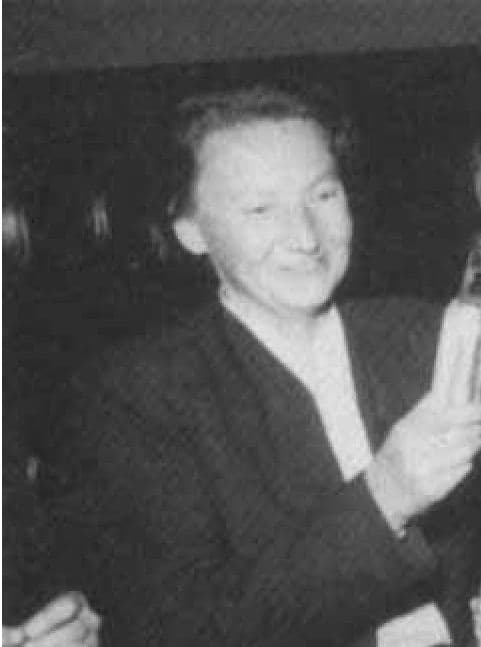
For a long time, Elfriede Husemann lived in the shadow of Hermann Staudinger, the founder of modern polymer chemistry. After his retirement, she took over the management of his institute at the University of Freiburg.
Elfriede Husemann was born in Gütersloh on 27 December 1908. Her talent for the natural sciences became apparent at school, and after completing her Abitur at the Auguste-Viktoria School in Bielefeld, she enrolled at the Albert Ludwig University of Freiburg im Breisgau to study chemistry. In autumn 1929, she moved to Leipzig, where she studied, among others, under the physical chemist and later Nobel Prize winner in Chemistry Peter Debye (1884–1966).
After completing her preliminary diploma in the summer semester of 1930, she returned to Freiburg. There, under the guidance of Eduard Zintl (1898–1941), she completed her doctoral thesis on magnesium compounds in 1933. As Zintl accepted a position in Darmstadt in autumn of the same year, Hermann Staudinger (1881–1965) wrote the report on Husemann’s dissertation. She received the grade “very good” for her doctoral thesis and oral examinations in chemistry, physics and mineralogy, as well as the academic degree “Dr. phil. nat.”
From 1933 to 1946, Husemann conducted research as an assistant in Staudinger’s laboratory, where she worked on macromolecules. In October 1939, she completed her habilitation with a thesis on the structure of wood polyoses, the polymeric carbohydrates in wood now known as hemicelluloses. Husemann was only the eighth female chemist in Germany to complete a habilitation. Her two assessors – Hermann Staudinger and Georg Wittig (1897–1987), both of whom later received the Nobel Prize in Chemistry – rated her habilitation thesis very highly, as Husemann had also worked on new methods for characterising high-polymer substances.
In the following years, Husemann’s collaboration with the physician Helmut Ruska (1908–1973), a senior employee at Siemens & Halke AG in Berlin, proved highly successful. Ruska is regarded as a pioneer of medical and bioscientific electron microscopy. Husemann, in turn, was the first to use electron microscopy in polysaccharide research. Her pioneering work made electron microscopy a valuable instrument for the optical visualisation of macromolecules. Based on these studies, Staudinger’s institute acquired an electron microscope in 1942, which Husemann looked after from then on.
Women in science faced considerable difficulties under the National Socialists, especially if, like Husemann, they did not belong to the NSDAP and did not wish to join the party. Nevertheless, 1942 marked a career leap in the life of the now 33-year-old scientist. Due to the shortage of teaching staff during the war years, she finally obtained a lectureship.
After the Second World War, in autumn 1945, Husemann helped rebuild the Chemical Institute in Freiburg. On Staudinger’s recommendation, she was appointed außerplanmäßige Professorin in January 1946. Despite limited financial resources, her research was crowned with success. She succeeded in optically visualising the polysaccharide amylopectin, the branched main component of plant starch, for the first time. Her work on elucidating the three-dimensional structure of amylose, the second main component of starch, also attracted particular attention. In addition to carbohydrate research, another of Husemann’s passions must not go unmentioned: she was an enthusiastic motorcyclist. Her rides into the surrounding heights of the Black Forest are legendary.
Husemann declined an offer from Jena and remained in Freiburg, even though the faculty’s application to establish an extraordinary professorship was repeatedly delayed – a typical problem faced by female scientists at the time, as Husemann put it. For a long time, she herself stood in the shadow of her “overfather” Staudinger, who received the undivided Nobel Prize in Chemistry in 1953. After Staudinger’s retirement in 1956, Husemann took over the management of his institute as an extraordinary professor. It was not until 1962 that she received the deserved appointment to the prestigious chair of macromolecular chemistry at the Albert Ludwig University of Freiburg. As Staudinger’s worthy successor, she developed the Freiburg institute into a modern centre for polymer science. Her best-known students include Beate Pfannemüller (1920–2008), Walter Burchard (born 1930) and Helmut Ringsdorf (born 1929).
Numerous publications, particularly on the chemistry of natural macromolecules, testify to Husemann’s creative energy and made her known far beyond Freiburg. For her findings in starch research, she received the Saare Medal in 1956, an award from the Working Group for Cereal Research. She retired in 1974.
Elfriede Husemann succumbed to cancer at the age of 67. She died in Freiburg on 9 November 1975.
Literature
de.wikipedia.org/wiki/Elfriede_Husemann
www.leo-bw.de/detail/-/Detail/details/PERSON/kgl_biographien/113303814X/Husemann+Elfriede
www.kipnis.de/index.php/alexander/kurzbiografien/169-husemann-elfriede-1908-1975-polymerchemikerin
academictree.org/chemistry/publications.php
Authors
Prof. Dr. Eberhard Ehlers
Prof. Dr. Heribert Offermanns
Editorial work
Dr. Uta Neubauer
Project management
Dr. Karin J. Schmitz (GDCh-public relations)
The authors are responsible for the content of the biographies.
The content presented on these pages has been carefully prepared. Nevertheless, the authors, Editorial staff and publisher accept no responsibility or liability for the completeness and accuracy of the content or for typographical errors.