Natural Compounds from Dillenia indica Target Hormonal and Non‐Hormonal Receptors in Triple‐Negative Breast Cancer: A Computational Analysis
Von Wiley-VCH zur Verfügung gestellt
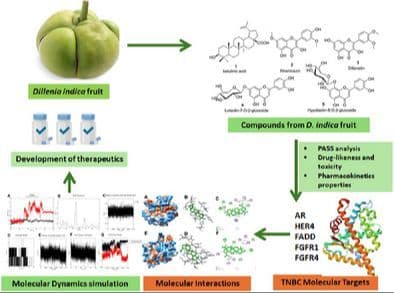
This study reveals the strong binding and stable interactions of molecules, viz. betulinic acid, dillenetin, rhamnazin, luteolin-7-O-β-D-glucoside (L7OBDG), and hypolaetin-8-O-β-D-glucoside (H8OBDG), derived from Dillenia indica against AR, HER4, FADD, and FGFR1 & FGFR4 associated with triple-negative breast cancer, which suggests therapeutic development against breast cancer.
Abstract
Triple-negative breast cancer (TNBC) provides a significant challenge in the field of breast cancer due to a lack of hormonal receptors and its aggressive characteristics. The present study employed computational techniques to examine the potential binding efficacy of molecules, viz. betulinic acid, dillenetin, rhamnazin, luteolin-7-O-β-D-glucoside (L7OBDG), and hypolaetin-8-O-β-D-glucoside (H8OBDG), derived from Dillenia indica (D. indica) against therapeutic targets such as androgen receptor (AR), human epidermal growth factor receptor 4 (HER4), FAS death domain (FADD), and fibroblast growth factor receptor (FGFR1 & FGFR4) associated with TNBC. The molecules were evaluated for their binding affinities and stability of interaction against targeted proteins using molecular docking and molecular dynamics (MD) simulation analysis, respectively. Comparing other molecules, betulinic acid exhibited strong binding affinity (−8.41, −7.41, −6.98, −7.03, and −8.75 kcal/mol) toward receptor proteins AR, HER4, FADD, FGFR1, and FGFR4, respectively. MD simulation analysis exhibited persistent interactions of betulinic acid with FGFR4 in contrast to AR protein over a 100 ns time-scale. ADME/toxicity prediction studies showed the drug-likeness pharmacokinetic properties of compounds. The findings of this study indicate the potential of D. indica compounds in the development of therapeutics against TNBC. Further preclinical and clinical evaluations are necessary to validate the findings.