B3N3Li6‐nH2 Complexes: A Computational Breakthrough in High‐Capacity and Stable Hydrogen Storage Systems
Von Wiley-VCH zur Verfügung gestellt
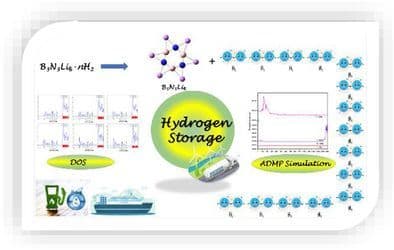
The B3N3Li6-nH2 complex is investigated as a lightweight superalkali-based hydrogen storage system. DFT and ADMP simulations reveal reversible physisorption of H2 molecules with adsorption energies in the optimal range (–0.123 to –0.100 eV), thermal stability up to 500 K, and a high storage capacity of ∼20.69 wt%.
Abstract
Efficient hydrogen storage is critical for enabling a sustainable energy future, demanding materials with exceptional capacity, reversibility, and stability under diverse conditions. Here, we investigate the hexalithioborazine (B3N3Li6) as a promising hydrogen storage system, leveraging its unique structural and electronic properties using density functional theory. Systematic adsorption energy analysis reveals highly favorable adsorption energies ranging from −0.123 to −0.100 eV, ensuring reversible hydrogen uptake. Remarkably, the B3N3Li6-6H2 complex achieves a hydrogen storage capacity of 9.44 wt%, surpassing DOE benchmarks, while adsorption extends up to 15H2 molecules, attaining an unprecedented capacity of 20.69 wt%. The stabilization arises from strong ion-induced dipole interactions between Li-atoms and H2 molecules, facilitated by charge transfer and polarization. Thermal stability of the B3N3Li6-6H2 system is validated through atom density matrix propagation (ADMP) simulations across a broad temperature range (0–500 K), demonstrating stability even at elevated temperatures. These findings may suggest B3N3Li6 as a transformative material for next-generation hydrogen storage technologies, bridging the theoretical potential and practical application gap.