Cotton Fabric and Polypropylene Fabrics Treated with Synthesized Zinc Diborate
Von Wiley-VCH zur Verfügung gestellt
In this study, anhydrous zinc diborate (ZnO.2B2O3 or Zn(B4O7)) powder is synthesized through wet chemical precipitation and thermal process, respectively. Impregnation with anhydrous zinc diborate (Zn(B4O7)) solution was applied to PP‒65, PP‒20, and C‒117 to make them environmentally friendly fabrics with high antimicrobial and thermal resistance.
Abstract
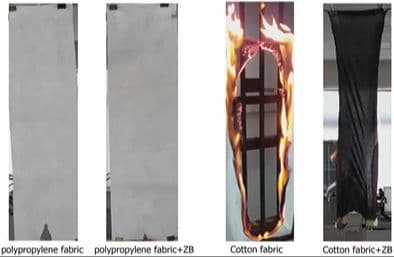
Cotton fabrics and polypropylene fabrics are mostly used fabrics in many areas. Zn(B4O7) powder was synthesized with a sequential wet precipitation and sintering method. Focused ion beam scanning electron microscopy (FIB-SEM) figures and energy dispersive X-ray spectroscopy (EDS) mapping results showed that zinc diborate was highly and homogeneously adsorbed on the surface of the treated fabrics. When differential thermal analysis (DTA) results were examined, heat release seemed to decrease by 0.71 kJ g−1, 0.61 kJ g−1, and 0.46 kJ g−1for cotton fabric treated with zinc diborate (C-117-ZB), polypropylene fabric (20 g m−2) treated with zinc diborate (PP-20-ZB), and polypropylene fabric (65 g m−2) treated with zinc diborate (PP-65-ZB), respectively. According to vertical burning test, burning rates of cotton fabric (C‒117), C‒117‒ZB, polypropylene fabric (PP‒65), PP‒65‒ZB, polypropylene fabric (PP‒20), and PP‒20‒ZB were calculated as 3.25 cm s−1, 1.93 cm s−1, 0.75 cm s−1, 0.36 cm s−1, 0.88 cm s−1, and 0.71 cm s−1, respectively. Heat releases and burning rate decreases were in good agreement for all treated fabrics. Also breaking strengths of both fabric types were improved. The washing test exhibited that the amount of zinc diborate powder on the cotton fabric sample was released by 25.49% while PP-65-ZB and PP-20-ZB fabrics released about 90% by weight of adsorbed powder. Although improvement was observed in the fire resistance of PP fabrics, antibacterial activity against Escherichia coli and Staphylococcus aureus could not be achieved. However, antibacterial activity was provided only for the cotton fabric.