Dual‐Layer Thin Film Coating for Solar Energy Harvesting
Von Wiley-VCH zur Verfügung gestellt
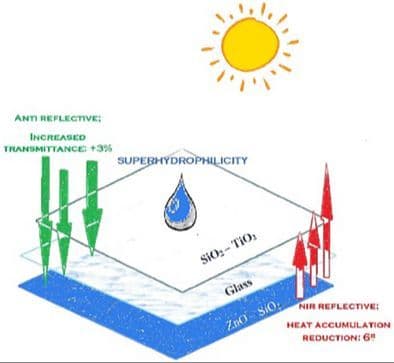
This study presents a dual-layer TiO2/SiO2 and ZnO/SiO2 coating designed for solar panels, which improves light transmission by 3%, reduces the temperature rise by 6 °C, and enhances self-cleaning performance due to its super-hydrophilic surface. The coatings improve the efficiency and durability of photovoltaic (PV) cells, providing a sustainable approach for solar energy harvesting.
Abstract
The efficiency of photovoltaic (PV) cells is significantly compromised by optical losses, surface contamination, and heat-induced degradation. While antireflective (AR) and self-cleaning coatings partially address these issues, their limited durability and inability to concurrently optimize optical, thermal, and mechanical performance hinder practical use. Here, we report a sol–gel spin-coated dual-layer thin film that decouples and integrates distinct functionalities: a TiO2/SiO2 top-layer for AR performance and self-cleaning, and a ZnO/SiO2 bottom-layer for near-infrared (NIR) reflection. A TiO2/SiO2 top-layer (C1) and a ZnO/SiO2 bottom-layer (C2) coated glass exhibited an average visible light transmittance of 94.1%, representing an increase of approximately 3.7% compared to bare glass via refractive index matching and optical interference, and reduces operating temperatures by 6 °C under IR irradiation—translating to a ∼3% PV efficiency improvement. Interface engineering at the TiO2/SiO2 boundary enhances surface hydroxylation, enabling super-hydrophilicity (7.5° water contact angle (WCA)) and photocatalytic degradation of organic contaminants. Mechanical durability, validated by pencil hardness (5H/4H) and adhesion tests (4B/5B), exceeds industrial standards for PV modules. By synergizing optical, thermal, and self-cleaning properties in a scalable coating, this work offers a practical pathway to enhance solar energy conversion in real-world environments.