Unveiling the Role of Low‐Coordinated Sites in CO2 Electroreduction Using Hierarchical Simulation Models
Von Wiley-VCH zur Verfügung gestellt
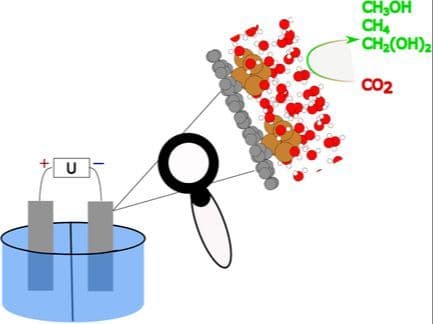
Designing an optimal catalyst for carbon dioxide electroreduction necessitates modeling various aspects of the actual catalyst. A hierarchical set of solvent models is setup, highlighting their potential applications and limitations in the electroreduction. The importance of the coordination numbers of the active sites is also demonstrated.
Enhancing efficiency and product selectivity presents a significant challenge in carbon dioxide electroreduction (CO2RR). Recent studies have demonstrated that the solvent in the electrolyte plays a crucial role; however, its specific functions are being investigated intensively. The study utilizes hierarchically assembled models, enabling to decoupling of the various effects of the solvent. Both (sub)nanoclusters and surfaces with adatoms are utilized as model systems, which allow to study the effect of the solvent on the low-coordinated reaction sites. It is observed that water binds to the low-coordination active sites of the catalytic centers, thereby influencing the reaction mechanism. This binding leads to significant charge transfer between the solvent and the catalyst, altering its charge state and the potential of zero charge—both of which are known to affect product selectivity. Additionally, a solvent-induced reorganization of the catalyst structure that can substantially influence reduction processes is observed. The solvation and solubility of the adsorbates also play a significant role, as they influence the desorption of the possible products from the catalyst surface.
Thus, the hierarchy of models presented here enables a systematic understanding of the microscopic role of solvents and paves the way for computational solvent engineering to optimize product selectivity in CO2RR.