Formosulfathiazole: A Structural Revision
Von Wiley-VCH zur Verfügung gestellt
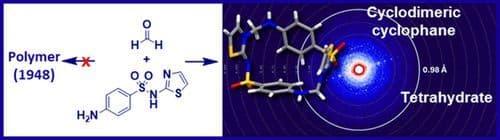
Formosulfathiazole (FSTz), a synthetic drug developed in 1948, is used to treat bacterial and protozoal infections in animals by slowly releasing sulfathiazole and formaldehyde. Structural analysis revealed that, contrary to earlier beliefs, FSTz features a well-defined cyclophane cyclodimeric structure rather than an undefined polymer.
Formosulfathiazole (FSTz) is a synthetic active pharmaceutical ingredient (API) prepared by condensation of sulfathiazole with formaldehyde. Originally described for the first time in 1948, it is currently used for the treatment of bacterial and protozoal infections in cattle and pets, acting as a prodrug slowly releasing the sulfamidic sulfathiazole and formaldehyde. A systematic analysis of FSTz allowed to revise the originally believed undefined polymeric structure and uncovered the intriguing cyclophane skeleton of a well-defined cyclodimeric condensation product.