Understanding the Temperature–Induced Decomposition of Commercial Nickel–Cobalt–Aluminum Oxide (LiNi0.8Co0.15Al0.05O2) Electrodes
Von Wiley-VCH zur Verfügung gestellt
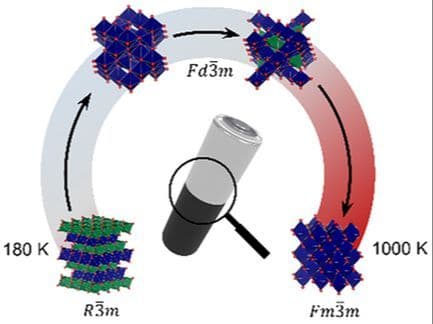
High-resolution X-ray diffraction and thermal analysis show the structural degradation of the NCA cathode from a layered structure over a spinel phase toward the rock salt structure within a temperature range from 180 to 1000 K.
This study addresses the thermal degradation and structural stability of the NCA (nickel–cobalt–aluminum oxide) cathode materials under varying states of charge (SOC)/delithiation and temperature. Using simultaneous thermogravimetric and differential thermal analysis and high-resolution X-ray diffraction, the sequential evolution from a layered NaCrS2-type structure to spinel phases (M3O4-type and LiM2O4-type) and finally to a rock salt phase is characterized. Degradation involves cation migration, oxygen release, and lattice instabilities, influenced by SOC/lithium content. Fully lithiated NCA (SOC 0%) exhibits superior thermal stability with a single-step transition, whereas partially delithiated NCA exhibits a multistep transformation process involving spinel intermediates. These findings highlight the complex interplay between energy density and thermal safety, offering guidance for designing NCA cathodes with optimized performance, safety, and stability for high-energy lithium-ion batteries.