Influence of Salt Concentration on the Electrochemical Performance of Magnesium Hexafluoroisopropoxy Aluminate Electrolyte
Von Wiley-VCH zur Verfügung gestellt
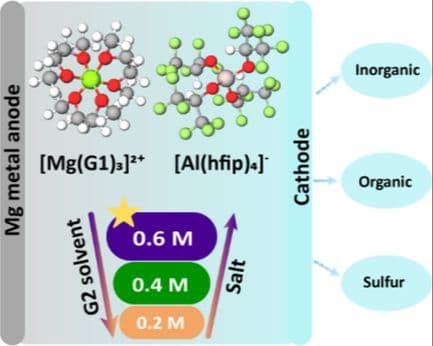
Salt concentration can have an important effect on the performance of electrolytes. Here, the influence of salt concentration on the physicochemical properties, salt-solvent interactions, and electrochemical performance of [Mg(G1)3][Al(hfip)4]2/G2 electrolytes is investigated. The results indicate that a higher salt concentration in the electrolytes generally improves cycling efficiency and stability of Mg metal anode and different cathode materials.
One of the challenges in the development of Mg batteries is the lack of Mg electrolytes with good compatibility with both the Mg metal anode and cathode materials. In recent years, Mg salts based on weakly coordinating anions have emerged as promising Mg electrolytes. In this work, we systematically investigate the effects of salt concentration on the physicochemical properties, salt–solvent interactions, and electrochemical performance of the Mg[Al(hfip)4]2/G2 electrolyte. Infrared (IR) and Raman spectroscopy are used to study the changes in the electrolyte speciation across different concentrations, indicating a decreased amount of free glyme solvent with higher salt concentration. Mg plating/stripping of selected electrolytes is evaluated through three different testing protocols (conventional cycling, macrocycling, and cycling with added open-circuit voltage (OCV) rests) and compatibility with different cathode materials such as Chevrel phase, sulfur, and various organic redox-active compounds. In the electrochemical tests, more concentrated electrolytes demonstrated improved cathode cycling efficiency and more stable Mg plating/stripping, making an argument for Mg electrolytes with higher salt concentration. However, higher salt concentrations can increase the cost of Mg electrolytes. Further Mg electrolyte optimization should focus on adjusting electrolyte composition to specific electrode materials and other cell components, while maintaining a reasonable cost.