Understanding the Role of Morphology in the Direct Synthesis of Diethyl Carbonate Over Ceria‐Based Catalysts: An In Situ Infrared and High‐Resolution TEM Study
Von Wiley-VCH zur Verfügung gestellt
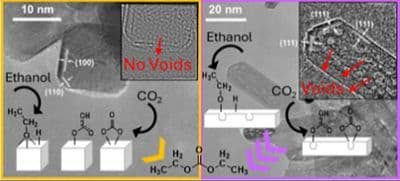
Pure and Zr-doped ceria-based catalysts with different morphologies were developed for the direct synthesis of diethyl carbonate from ethanol and CO2. Rod-shaped pure CeO2 outperformed the other samples, thanks to abundant structural defects and high basicity. In situ FTIR analysis revealed distinct ethanol activation pathways depending on morphology with formation of more reactive ethoxy intermediates on void-abundant surfaces.
Abstract
The direct CO2 conversion to organic carbonates such as diethyl carbonate (DEC) offers a safer alternative to conventional hazardous routes involving toxic reagents. However, the thermodynamic stability of reactants poses challenges to efficiency. In this work, nanosized ceria-based catalysts with varying morphology were synthesized through precipitation and hydrothermal method and tested to investigate the mechanism of DEC synthesis from ethanol and CO2. In situ Fourier transform infrared (FTIR) spectroscopy revealed that CO2 is mostly adsorbed in the form of bicarbonates and bidentate carbonates, while type I standing-up ethoxy are the most reactive ethoxy species. Additionally, signals related to the formation of monoethyl carbonate intermediate were also identified in the IR spectra collected during exposure of ethanol-saturated ceria to CO2. High-resolution TEM analysis revealed that the rod-shaped morphology exhibits a greater abundance of surface defects, such as nanovoids and surface steps, compared to the cube and nanoparticle ones, responsible for the highest activity of the rod ceria catalyst. The rod-shaped catalyst retained high performance over four sequential regeneration and reuse cycles, demonstrating its stability and reusability. These findings provide key insights into the structure-activity relationship of ceria-based catalysts, offering a promising pathway for improving DEC synthesis from CO₂.