Review on the Pivotal Role of Interfacial Sites in Multicomponent Catalysts for Promoting Selective COx Hydrogenation to Ethanol
Von Wiley-VCH zur Verfügung gestellt
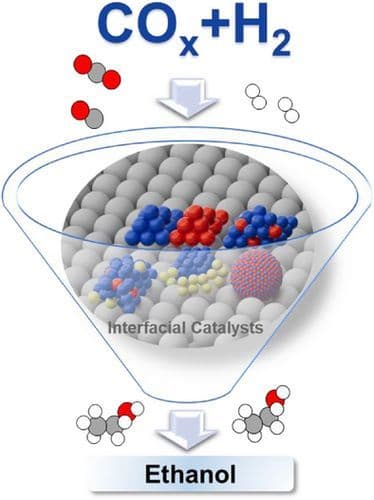
This review demonstrates that engineering the interfacial sites in a catalyst enables precise control over the reaction pathway for direct ethanol synthesis from COx (CO/CO2) and H2. The tailored interface structure facilitates C─C coupling and intermediate hydrogenation, significantly enhancing ethanol production rate and long-term stability, thereby providing a novel design principle for sustainable catalyst synthesis.
Abstract
With growing emphasis on circular carbon economy, catalytic CO x (CO/CO2) conversion offers a sustainable route for ethanol synthesis, yet challenges persist in achieving high selectivity due to competing single-carbon products formation (e.g., CO, methane, and methanol formation). Multicomponent catalysts, which consist of two or more distinct metal species with cooperative synergistic interactions between discrete active sites, exhibit high ethanol selectivity in COx hydrogenation reactions. Here, this review comments on the critical role of interfacial sites, where metal–metal or metal–oxide interactions modulate electronic and geometric properties, in multicomponent bifunctional catalysts for selective COx hydrogenation to ethanol. We first highlight how engineered metal–oxide interfaces and nanoscale metal intimacy (e.g., in Rh-, Cu-, Co-, and in-based multicomponent bifunctional catalysts) synergistically activate CO x , stabilize key intermediates (e.g., CH x*, CO*, and CHxO*), and thereby promoting C─C coupling. Advanced strategies, including atomic layer deposition (ALD), surface organometallic chemistry (SOMC), and strong electrostatic adsorption (SEA), for engineering interfacial sites are then discussed. The mechanistic insights (obtained from advanced characterization) into these catalytic systems are then discussed, followed by the proposed future research avenues for the field. This review serves as the roadmap for developing efficient catalysts to advance COx-to-ethanol technology.