Transfer Hydrogenation Catalyzed by a Bifunctional Cobalt‐Based Supramolecular Complex Offering Hydrogen Bonding Cavities
Von Wiley-VCH zur Verfügung gestellt
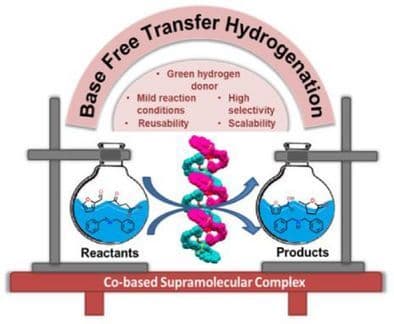
A Co-containing supramolecular complex, offering both Lewis acidic–basic and Brønsted acidic sites, functions as a remarkable heterogeneous catalyst for promoting the base-free transfer hydrogenation of assorted carbonyl and imine substrates with high conversions and exclusive selectivity.
Abstract
A cobalt-containing supramolecular complex, Co-L, is presented, offering dual functionalities. Co-L contains both Lewis acidic–basic sites provided by the cobalt ions and hydroxyl groups, and Brønsted acid sites from the free carboxylic acid groups. This complex forms a 3D layered structure via assorted intra-layer and inter-layer hydrogen bonds. Functioning as a heterogeneous catalyst, Co-L efficiently promotes the base-free transfer hydrogenation of carbonyl and imine compounds, while using environmentally benign isopropanol as a hydrogen donor. The Co-L illustrates remarkable catalytic activity across diverse substrates, including aldehydes, ketones, and imines, achieving high conversions and exclusive selectivity. The biomass-derived substrates, such as furfural, levulinic acid, and 5-methylfurfural, along with pharmaceutically significant ones, such as cinnamaldehyde and estrone, were effectively transformed to their target products. The mechanistic studies revealed a synergy between the Lewis acid–base pairs (Co2+/OH−) and Brønsted acid sites (-COOH) during the catalysis. A combination of spectral and molecular docking studies asserts the role of dual functionalities in Co-L. An ester analogue of Co-L, EtCo-L, showed lower catalytic activity, asserting the role of Brønsted acidic groups.