CBr4 as an Efficient Halogen Bond Donor Catalyst in Pictet–Spengler Cyclizations: A Metal‐Free Approach to the Synthesis of Benzazepinoindoles and Tetrahydro‐β‐carbolines
Von Wiley-VCH zur Verfügung gestellt
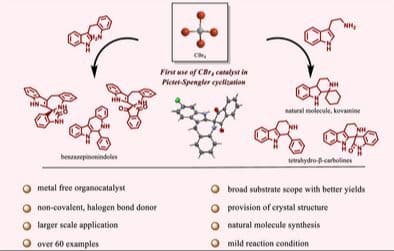
This study introduces CBr4 as the first organocatalyst for the Pictet–Spengler cyclization, enabling the efficient synthesis of diverse indole-based frameworks, including spirobenzazepinoindoles, tetrahydrobenzazepinoindoles, and tetrahydro-β-carbolines. The method exhibits broad substrate tolerance and high yields, exemplified by the synthesis of the bioactive natural product kovamine. It‘s successful gram-scale application highlights the practical significance and scalability of this CBr4-catalyzed protocol.
Abstract
Indole-based alkaloids, such as benzazepinoindoles and tetrahydro-β-carbolines, hold profound significance in synthetic organic chemistry due to their diverse biological properties. These structurally intricate molecules are efficiently accessed through the well-established Pictet–Spengler cyclization, a reaction that entails the condensation of amines with carbonyl compounds, followed by an intramolecular cyclization. This transformation was effectively catalyzed by tetrabromomethane (CBr4), an effective metal-free organocatalyst that facilitates high-yielding reactions while accommodating a broad substrate scope. The remarkable adaptability of this strategy enables the construction of a variety of architecturally distinct frameworks, including seven-membered spirobenzazepinoindoles, tetrahydrobenzazepinoindoles, and six-membered tetrahydro-β-carbolines, notably encompassing the naturally occurring alkaloid kovamine. The synthesized compounds were extensively characterized using spectroscopic techniques such as NMR (1H, 13C, 19F, and DEPT-135), IR, and mass spectrometry. NMR titration analysis, alongside DFT computations, were performed to elucidate the molecular-level interactions between CBr4 and carbonyl functionalities.