Thermally Stable LiNi0.6Mn0.15Co0.15Al0.05Ti0.05O2 Layered Cathode for Lithium‐Ion Batteries: Experimental and Theoretical Study
Von Wiley-VCH zur Verfügung gestellt
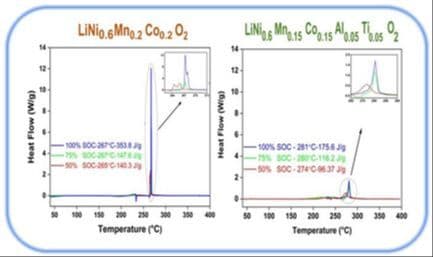
The incorporation of aluminum (Al) and titanium (Ti) in the NMC622 has resulted in improved thermal stability, enabling the material to withstand temperatures up to 280°C.
Lithium-ion batteries (LIBs) have gained widespread adoption in the automotive and smart electronics industries. However, there are growing public concerns regarding the potential risk of thermal runaway incidents, which can be triggered by internal short circuits, overcharging, or physical damage. To ensure the safety of battery systems and minimize the risk of thermal runaway, it is essential to prioritize design, safety protocols, and material selection. The choice of cathode material is particularly significant in mitigating this risk. In response to this challenge, a thermally stable cathode material called LiNi0.6Mn0.15Co0.15Al0.05Ti0.05O2 (NMCAT) has been formulated here and its structural, morphological, electrochemical, and thermal characteristics are investigated. The thermal and electrochemical characteristics of NMCAT have revealed promising findings. The incorporation of aluminum (Al) and titanium (Ti) in the cathode formulation has resulted in improved thermal stability, enabling the material to withstand temperatures up to 280 °C without compromising its capacity. Further, a detailed atomic-level understanding of the thermal stability has been revealed through first-principles calculations, which complement the experimental data. This breakthrough in enhancing thermal stability is essential for mitigating the risks associated with thermal runaway in LIBs from a material perspective.