TASK2‐Inspired pH‐Gating Polymeric Nanochannels with Multiple Interconvertible Permeability States by Synergistic Regulation of Conformation and Charge
Von Wiley-VCH zur Verfügung gestellt
To mimic precise permeation regulation of biological ion channels, an extrinsic-gate composite strategy is provided to build smart polymeric nanochannels with four ion permeability states in response to pH stimuli. Beneficial for synergy transformation of structure and charge properties, the nanochannels achieve pH-gating on–off switch of fast cation flux, superhigh cation/anion selectivity, and salinity-gradient energy transduction, respectively.
Abstract
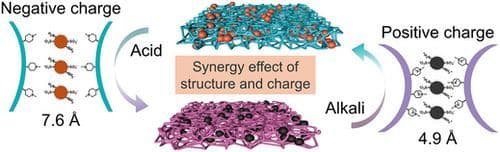
Biological ion channels can regulate finely the ion transmembrane permeation, with superhigh ion selectivity and on–off ion flux in response to external stimuli, for signal transduction and energy conversion. However, fabricating smart artificial nanochannels with analogous functions remain challenging by single design of structure or charge property. In vivo, function basis of pH-gated TWIK-related acid-sensitive K+ channel 2 (TASK2) channels is attributed to synergy control of geometrical conformation and surface potential for filter gates. With this inspiration, we report an extrinsic-gate composite strategy to construct biomimetic responsive nanochannels, based on dye-loading branched poly(piperidine)s. Two nanochannel models, negatively-charged large pores (0.76 nm) and positively-charged small pores (0.49 nm), can be switched quickly by external pH stimuli, due to protonation/deprotonation and conformation change of gates. Thereby, symmetric and asymmetric pH stimuli at the two sides of nanochannels achieve four distinct permeability states to various ions, respectively, to mimic inactivated, inhibited, rest, and activated states of TASK2 channels. Applying for salinity-gradient energy conversion, the high-selectivity/high-flux states (SNa+/Cl−∼3332) and low-selectivity and low-flux permeability states (SNa+/Cl−∼0.33) act as an on–off switch of salinity-gradient energy nanogenerator, with superhigh energy conversion efficiency of ∼50%. This work suggests the potential of extrinsic-gate composite nanochannels for in vitro biomimetic applications.