Bio‐Transport Regulation Inspired 5‐Fluorouracil Keto to Enol Tautomerism Achieving High Proton Conductivity

Von Wiley-VCH zur Verfügung gestellt
Bio-inspired proton transport regulation via 5-fluorouracil tautomerism within sulfonated MOF-808 to reconcile the inherent trade-off between low activation energy and sustained proton mobility
Abstract
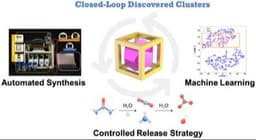
The strategic modulation of proton transport kinetics and precise control of migration energy barriers in metal-organic frameworks (MOFs) are essential for developing next-generation proton conductors. Inspired by biological proton channels, this study introduces a dynamic regulation strategy by keto-enol tautomerism to reconcile the intrinsic trade-off between low activation energy (E a) and sustained proton mobility. We successfully construct a hierarchical proton conductive system (denoted as FU@MOF-808-SO3H) by integrating 5-fluorouracil (5-FU) molecules into sulfonic-functionalized MOF-808 through a two-step post-synthetic modification. The enol tautomer of 5-FU reconfigures hydrogen-bond networks under humidity variations, synergizing with anchored ─SO3H groups to establish proton transport pathways along ordered ionic channels (─SO3H···H2O···5-FU) and tautomerism-driven delocalization via reversible keto-enol isomerization. The optimized compound FU@MOF-808-SO3H exhibits a high proton conductivity of 7.15 × 10⁻² S cm−1 at 353 K and 95% RH, representing an approximate 300-fold enhancement over pristine MOF-808, a 15-fold improvement versus the 5-FU-encapsulated analogue FU@MOF-808, and the sulfonated framework MOF-808-SO3H. Density functional theory (DFT) calculations elucidate an ultra-low formation energy barrier (9.05 and 1.59 kcal mol−1) from keto to enol conversion, attributed to sulfonic acid stabilization of protonated transition states. Furthermore, the proton conductive mechanism is visually corroborated by molecular dynamic (MD) simulation, suggesting Grotthuss-dominated proton migration within hydrated nanochannels, aligning with experimental results.