Tailoring Tubular Supramolecular Polymers with Polar Lumens to Host Hydrophilic Dye Molecules
Von Wiley-VCH zur Verfügung gestellt
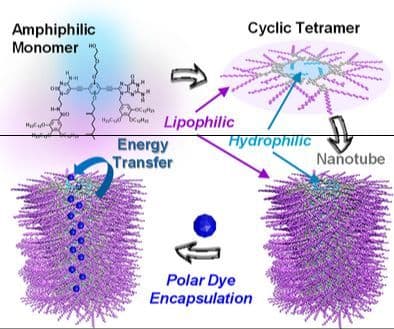
A unique class of tubular polymer structures that are soluble in apolar organic solvents but are endowed with polar pores has been created through the rational design of the monomer units, which self-assemble in amphiphilic cyclic entities that then stack into tubular architectures. These tailored assemblies are able to selectively host hydrophilic dye molecules that are complementary in size and chemical affinity for the pore coating, providing containers for the study of energy transfer processes.
Abstract
Supramolecular polymers are living an intense research period in which new synthetic strategies, unusual morphologies, and diverse promising applications are being explored. We contribute here to this field with the development of a unique class of supramolecular polymers that are able to selectively encapsulate guest molecules within their lumen. This is achieved through a rational design of the monomer units, which self-assemble in amphiphilic cyclic entities that then stack into lipophilic tubular architectures that contain a polar pore. These tailored assemblies are able to host hydrophilic dye molecules that are complementary in size and chemical affinity for the pore coating. Dye extraction is characterized by: (1) the emergence of the dye absorption and emission features in solution, (2) a red shift of the absorption and emission maxima, caused by a confined environment of high viscosity, and (3) an energy transfer process from the monomer at the tube's walls to the included dye guest, which was characterized by photoluminescence (PL), excitation, and transient absorption measurements. When different dyes are co-encapsulated, the tubular supramolecular polymer provides a unidimensional confined chiral environment to promote sequential energy transfer processes between them.