Tailoring Co Coordination Mode in COF Nanosheets for Efficient Solar‐Driven Reduction of Non‐Neat CO2 into Syngas
Von Wiley-VCH zur Verfügung gestellt
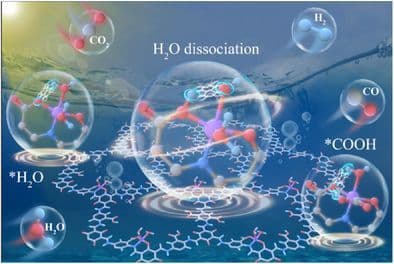
A metal-covalent organic framework nanosheet constructed from an asymmetric tridentate ligand structure was designed for the photoreduction of CO2 to syngas under different contents of CO2 and natural sunlight. The carboxyl group in the asymmetric tridentate ligand structure facilitated dissociation of water to generate *H by hydrogen bond. Moreover, *H assists CO2 (g) adsorption and lowers the energy barrier for *COOH formation.
Abstract
Photocatalytic conversion of CO2 into syngas is a promising approach to solving energy and environmental challenges. However, the current studies are mainly conducted by using neat CO2 where CO2 enrichment and purification is an energy-intensive process. Herein, we report a Co-COOH-COF with an asymmetric tridentate ligand for syngas synthesis from different contents of CO2. The nanosheets of the resulting champion catalyst, Co17.7-COOH-COF enable an outstanding syngas production rate of 151.1 mmol g−1 h−1 from neat CO2 and 180.5 mmol g−1 h−1 from 40 vol% CO2 under visible light, while it is up to 112.3 mmol g−1 h−1 from neat CO2 and 116.0 mmol g−1 h−1 from 40 vol% CO2 under natural sunlight, which surpasses most of the previously reported state-of-the-art photocatalysts. Impressively, the catalyst also exhibits a widely and continuously adjustable CO/H2 molar ratio from 4:1 to 1:21. Experimental and theoretical studies indicate that the asymmetric tridentate ligand with carboxyl groups increases Co loading in the covalent organic frame (COF) by the formation of atomically dispersed N–Co–O4 sites and enhances dissociation of water and CO2 adsorption by hydrogen bonding, thus facilitating CO2 transformation and hydrogen evolution. This work presents a new pathway for the design of high-performance catalysts for the photoreduction of CO2 to syngas.