Synthesis and Application of Geminal Halodiborylalkanes: Recent Advances and Future Perspectives
Von Wiley-VCH zur Verfügung gestellt
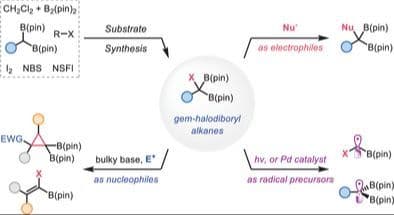
Geminal halodiborylalkanes have emerged as versatile reagents enabling a broad range of transformations as electrophiles, nucleophiles, and radical precursors. This review summarizes recent advances in their synthesis and applications, highlighting key strategies, mechanistic insights, and future opportunities in organoboron and radical chemistry.
Abstract
Geminal halodiborylalkanes have recently emerged as a distinctive class of organoboron reagent, enabling diverse synthetic transformations. Their characteristic structure features an ambiphilic carbon center bearing one halogen and two boryl groups, offering opportunities for programmable functionalization. This review provides an overview of recent advances in the synthesis of gem-halodiborylalkanes, with an emphasis on methods that enhance practicality, functional group tolerance, and scalability. Furthermore, we cover the growing application of gem-halodiborylalkanes as electrophiles, nucleophiles, and particularly as radical precursors in photocatalyzed or palladium-catalyzed transformations. Mechanistic understanding and challenges associated with these reactions are also discussed, aiming to offer a perspective on future developments in this field.