Revealing the Role of the Confining Effect of Nanoporous Carbons in the Catalytic Conversion of Ethylene on NiMo Catalysts
Von Wiley-VCH zur Verfügung gestellt
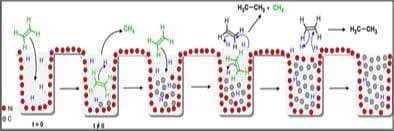
Mechanism for the hydrogenolysis/hydrogenation reactions of ethylene is discussed. After getting into the nanopore framework of the AC-CO2, ethylene reacts with the active metal phase, yielding mainly methane and carbon nanotubes. Thereafter active metal diffuse together with the carbon tubes and once it is on the surface of support, the reaction between ethylene and metal sites yields selectivity ethane.
Abstract
The influence of texture and surface chemistry of porous carbons on the activity, selectivity, and stability of Ni, Mo, and NiMo-based catalysts was verified in the hydrogenation of ethylene. A homemade nanoporous carbon was prepared from pine bark and compared against two commercial activated carbon-supported NiMo catalysts. The temperature and type of reducing pretreatments were studied, and results showed that nanoporous carbon-supported NiMo catalysts are less prone to deactivate than catalysts supported on commercial micro- or mesoporous activated carbons. The careful characterization of catalysts performed before and after reaction suggests that the selectivity of gaseous products can be related to a confining effect of ethylene within the nanopores of the carbon support. Nanoporous carbon-supported Ni and NiMo catalysts did not deactivate due to the formation of carbon nanotubes, permitting the diffusion of active Ni nanoparticles from the pore framework to the surface of the catalysts, inducing changes in the selectivity of gaseous products along the reaction. A schematic mechanism of reaction explaining the hydrogenolysis/hydrogenation selectivity is proposed based on the changes in selectivity of gaseous products and the postmortem characterization of catalysts, referring to the surface chemistry, formation of carbon nanotubes, diffusion of metallic species, and changes in the porosimetry of catalysts.