Recent Advances in the Biosynthetic Studies of Sordarin
Von Wiley-VCH zur Verfügung gestellt
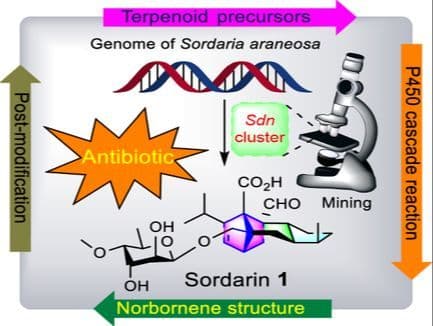
Recent breakthroughs characterize the biosynthesis of fungal antibiotic sordarin. The pathway begins with terpenoid scaffold formation. Four successive cytochrome P450-mediated oxidations cascade, including a key CC bond cleavage. A distinct Diels–Alderase enzyme SdnG then stereoselectively builds the norbornene core. Late-stage biosynthesis involves glycosyl transferase-catalyzed sugar attachment and further redox tailoring, producing the antibiotic.
Sordarin, a structurally distinct natural product-derived antifungal antibiotic targeting eukaryotic translation elongation factor 2, has undergone extensive biosynthetic characterizations in recent studies. This review highlights key advances in understanding its biosynthesis. These insights offer critical pathways for designing next-generation antifungal agents to address emerging resistance mechanisms.