Homogeneous Electrochemical Enzyme‐Linked Immunosorbent Assay Strategy Based On pH‐Mediated Redox Potential Regulation
Von Wiley-VCH zur Verfügung gestellt
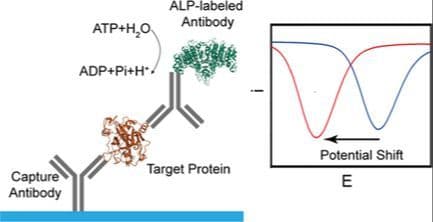
A homogeneous electrochemical enzyme-linked immunosorbent assay platform is developed, which simplifies and accelerates signal acquisition in field settings. Target-induced pH change is carefully investigated. Highly sensitive, reproducible, and quantitative electrochemical detection is achieved with C-reactive protein as a model target.
Enzyme-linked immunosorbent assay (ELISA) is widely recognized as the gold standard for protein detection. However, its reliance on expensive and bulky optical instruments limits its use in point-of-care and resource-limited settings. Electrochemical technique emerges as a promising alternative due to its low cost, portability, and simple instrumentation. However, conventional electrochemical methods often require complex surface modifications and suffer from variability between electrodes. To overcome these limitations, a novel homogeneous electrochemical ELISA platform has been developed, that simplifies and accelerates signal acquisition in field settings. This platform leverages pH changes caused by alkaline phosphatase-catalyzed hydrolysis of ATP, resulting in solution acidification. These pH variations are sensitively detected through shifts in the redox potential of methylene blue (MB), a proton-sensitive electrochemical probe. By quantitatively correlating the target protein concentration with MB redox potential shift, a sensitive, reproducible, and quantitative electrochemical detection of a model protein, C-reactive protein, is achieved. This versatile and cost-effective approach holds significant potential to expand the applicability of ELISA to point-of-care diagnostics.