Quasi‐Homogeneous Photocatalytic C─H Functionalization Enabled by Donor–Acceptor Microporous Polymer Aerogels Featuring Ultralong‐Lived and Long‐Range Excitons
Von Wiley-VCH zur Verfügung gestellt
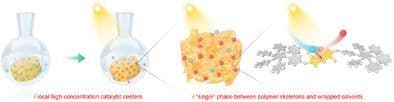
We report the construction of conjugated microporous polymer aerogels featuring ultralong-lived excitons, high-concentration local catalytic centers, and a hierarchically porous gel network that wraps solvent and reactants to provide a “single” reaction phase without interfacial resistance. The aerogels as quasi-homogeneous photocatalysts show general applicability to four C─H functionalization reactions, achieving remarkable conversion efficiencies, gram-scale productivities, and recyclability.
Abstract
Simultaneous promotion of charge and mass transportation between catalytic centers and reactants is crucial for photocatalysis but remains a substantial challenge on account of the widespread use of homogeneous or heterogeneous photocatalysts that suffer from sluggish reactant-diffusion kinetics or interfacial electron-transport resistance, respectively. Herein, we demonstrate the construction of conjugated microporous polymer aerogels as available quasi-homogeneous photocatalysts by integrating structural designability, which allows for the incorporation of electron-acceptor building blocks featuring ultralong-lived excitons as high-concentration local catalytic centers, and hierarchically porous gel networks that wrap solvent and reactants to provide a “single” reaction phase without interfacial resistance. A total of 18 samples of C─H functionalization reactions underpinned by four different mechanisms were screened to showcase the general applicability of the obtained aerogel photocatalysts, which achieved remarkable conversion efficiencies, gram-scale productivities, and recyclability. By combining a designable structure for photophysical properties with hierarchical porosities for optimal charge/mass transfer, we believe microporous polymer aerogels can serve as a versatile design platform for quasi-homogeneously photocatalyzing challenging reactions.