Propelling Chan‐Lam Cross‐Coupling Through Photocatalysis and Electrocatalysis: An Update
Von Wiley-VCH zur Verfügung gestellt
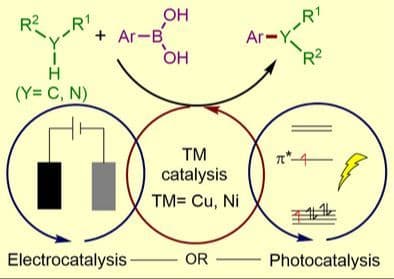
In recent years, the classical modus operandi of Chan-Lam cross-coupling has seen a paradigm shift to contemporary modes like visible-light photocatalysis and electrocatalysis. These techniques can bring about improved transformations compared to the established protocols, while being compatible with traditionally difficult substrates like electron-poor boronic acids. A major advantage is that they can facilitate Chan-Lam reactions even without external-oxidants.
Abstract
Contemporary modes like photocatalysis and electrocatalysis can not only bring about transformations equivalent to the existing conventional Chan-Lam methodologies but are also compatible with traditionally difficult substrates, particularly electron-deficient aryl boronic acids. Transition metals like IrIII and RuII behave as single-electron oxidants under visible light. Primarily, photocatalyzed Chan-Lam reactions commences from the usual Cu/Ni-catalyzed Chan-Lam reaction mechanism. Simultaneously, the photocatalytic cycle gets initiated from a visible light induced MLCT to produce an excited metal-complex; which then undergoes SET to facilitate the final oxidation step from CuI → CuII of the mechanistic cycle. Photocatalysts can thus circumvent the need of external oxidants. Other interesting reaction mechanisms involving a proton coupled electron transfer (PCET) process, a photocatalytic-autocatalytic mechanism, a dual-photoexcitation mechanism are also discussed in this review. Heterogeneous catalysts with a suitable band-gap also behave as photocatalysts due to creation of electrons and holes on photoirradiation of the metal surface. On the other hand, electrocatalysis plays a significant role in refining the CuI generated during the reaction and thus grants an improved reaction side-product profile. Electrocatalyzed Chan-Lam reactions through the use of pulsed electrochemistry technique and redox mediators are also discussed in the review.