Investigation of Phosphine Ligand Effect on Tunable Optical Property of Novel Coumarin‐Triphenyliminophosphorane Fluorophores
Von Wiley-VCH zur Verfügung gestellt
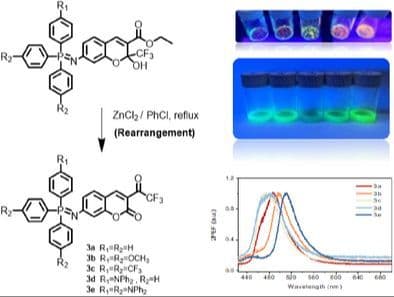
Novel coumarin-triphenyliminophosphorane (TPIPP) fluorophores with tunable optical properties are successfully synthesized via acid-promoted chromene-to-coumarin rearrangement strategy. The electronic effects of para-substituted phosphine ligands enable precise wavelength control over both absorption and emission spectra spanning blue to green regions, while simultaneously exhibiting remarkable two-photon-excited fluorescence (2PEF) under near-infrared laser excitation, offering promising potential for bioimaging applications.
Abstract
We report the synthesis and investigation of the photophysical properties of a series of coumarin-triphenyliminophosphorane (TPIPP) derivatives containing an electron-withdrawing trifluoromethyl ketone (TFMK) group at the C-3 position. The concept of nonhydrolytic Staudinger reaction (NSR) was employed to prepare stable coumarin-TPIPP compounds, and introduction of para-substituted electron-donating or electron-withdrawing groups on the PPh3 ligands significantly influenced the optical behavior of the coumarin-TPIPP derivatives. Compounds with more electron-donating substituents exhibited red-shifted absorption and emission maxima, as well as enhanced two-photon absorption (2PA) properties under near-infrared excitation. The substituent effect on the ground and excited-state dipole moments was also investigated using the solvatochromic shift method, revealing a decrease in the dipole moment change as the number of para-substituents increased. The polarized P═N bond feature, along with the favorable intramolecular charge transfer process, contributes to 2PA behavior of the coumarin-TPIPP compounds with tunable fluorescence profiles, providing a promising strategy for the design of novel luminescent materials.