Production of High Tensile Strength Bio‐Based Carbon Fibers: Advances, Challenges, and Emerging Applications
Von Wiley-VCH zur Verfügung gestellt
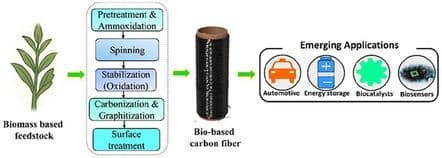
This review summarizes recent advances in the production of carbon fibers from various bio-based feedstocks following pre-treatment and ammoxidation, spinning, stabilization, carbonization, and graphitization. It also highlights the prospects and challenges associated with the use of bio-based carbon fiber in various emerging applications, including automotive components, energy storage, biocatalysis, and biosensing.
Abstract
The transition to sustainable materials has spurred significant interest in high tensile strength bio-based carbon fibers (CFs), which utilize renewable precursors such as lignin, cellulose, and bio-polyacrylonitrile (bio-PAN). Recent advancements in lignin fractionation and cellulose processing have enabled the production of bio-based CFs with tensile strengths approaching 1.72 and 172 GPa of moduli, narrowing the gap with petroleum-based counterparts. Innovations in stabilization and carbonization, including low-energy microwave techniques, have reduced energy requirements by up to 30%, enhancing economic feasibility. Despite these advances, challenges persist, such as the heterogeneity of lignin precursors, high production costs, and scalability barriers, which currently limit widespread adoption. Future opportunities lie in tailoring precursor molecular structures through genetic engineering and developing hybrid materials that combine bio-based and traditional fibers to optimize performance. With the potential to reduce carbon emissions by 50% and utilize abundant industrial by-products, bio-based CFs represent a pivotal step toward sustainable high-performance materials. These fibers promise transformative impacts across sectors such as supercapacitors, batteries, biosensors, biocatalytic materials and automotive, aligning material innovation with global environmental goals.