Preintercalation Induced Transition from Double Layer to Redox Calcium‐Ion Storage in Vanadium Carbide MXene
Von Wiley-VCH zur Verfügung gestellt
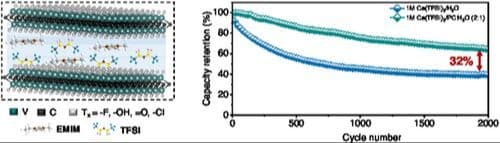
Preintercalated V2CT x MXene exhibits pseudocapacitive charge storage behavior in Ca-ion based aqueous electrolytes1-ethyl-3-methylimidazolium bis(trifluoromethanesulfonyl)imide, where confined ionic liquid facilitaes rapid Ca-ion diffusion. Specific capacity of V2CT x is retained upto 70% in hybrid propylene carbonate-warer (2:1) electrolyte over 2000 cycles.
MXenes are a versatile class of two-dimensional (2D) materials that exhibit proton-induced pseudocapacitance, however, intercalation capacitive behavior in neutral electrolytes limits the charge storage capacities. In this work, the design of pseudocapacitive vanadium carbide (V2CT x ) MXene electrodes in calcium-ion electrolytes is reported. By incorporation of room temperature ionic liquid, 1-ethyl-3-methylimidazolium bis(trifluoromethanesulfonyl)imide (EMIM-TFSI), as a preintercalant, a transition from electrical double layer to redox charge storage is observed. Facile diffusion of high charge density Ca-ions to inaccessible surface-active sites is enabled by the confined fluid effect of ionic liquid, results in a specific calciation capacity of 116 mAh g−1 at a current density of 0.05 A g−1. However, inevitable capacity loss limits the long-term stability, which is possibly due to spontaneous intercalation of water leading to plausible (electro)chemical dissolution of V2CT x MXene in aqueous Ca-ion electrolyte as confirmed by in situ X-ray diffraction studies. By the optimal choice of a hybrid electrolyte consisting of propylene carbonate and water, the charge storage capacity is improved up to 180 mAh g−1 at a current density of 0.09 A g−1 with an enlarged potential window of 1.6 V and capacity retention of 70% over 2000 cycles. This study opens avenues for exploring hybrid electrolytes toward long-term cycling stability of MXene electrodes.