Pancatalytic Tumor Therapy by Ultrasound Activation of Inorganic Sonosensitizers
Von Wiley-VCH zur Verfügung gestellt
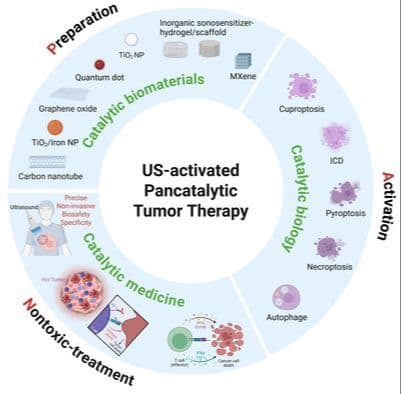
Ultrasound (US)-activated pancatalytic therapy mediated by sonosensitizers represents a paradigm shift, offering unprecedented spatial specificity and depth penetration capabilities. Herein, the state of US-activated pancatalytic tumor therapy is summarized, focusing on the classification and design principles of inorganic sonosensitizers, the cancer therapeutic efficacy enabled by sonocatalytic effect, and biosafety considerations for clinical use.
Pancatalytic therapy (PCT) is a comprehensive framework for disease management through the holistic control of catalytic and quasi-catalytic processes, including preparation (P) of catalysts, activation (A) of specific bio-effects, and nontoxic treatment (N) of different diseases. Ultrasound (US)-activated inorganic sonosensitizers have emerged as a powerful platform for pancatalytic tumor therapy, enabling precise and noninvasive cancer treatment through localized reactive oxygen species (ROS) generation by the specific sonocatalytic mechanism. Upon exposure to US activation, inorganic sonosensitizers generate electron–hole pairs that produce sonocatalytic effect, generating cytotoxic ROS to induce oxidative damage in tumor cells. With ongoing advances in nanomaterial design and US technology, inorganic sonosensitizers represent a transformative approach for precision oncology, offering a versatile and clinically translatable solution for the emerging pancatalytic tumor eradication. This comprehensive review summarizes and highlights recent developments in different kinds of inorganic sonosensitizers and their specific application for pancatalytic tumor therapy. This review begins with providing an overview of inorganic sonosensitizers. The focus is then shifted to US-activated pancatalytic tumor therapy with high therapeutic efficacy. The biosafety and biospecificity of US-activated sonosensitizers in combating tumor are further discussed. Finally, the critical challenges and perspectives on potential directions for future clinical translation of this technology are presented.